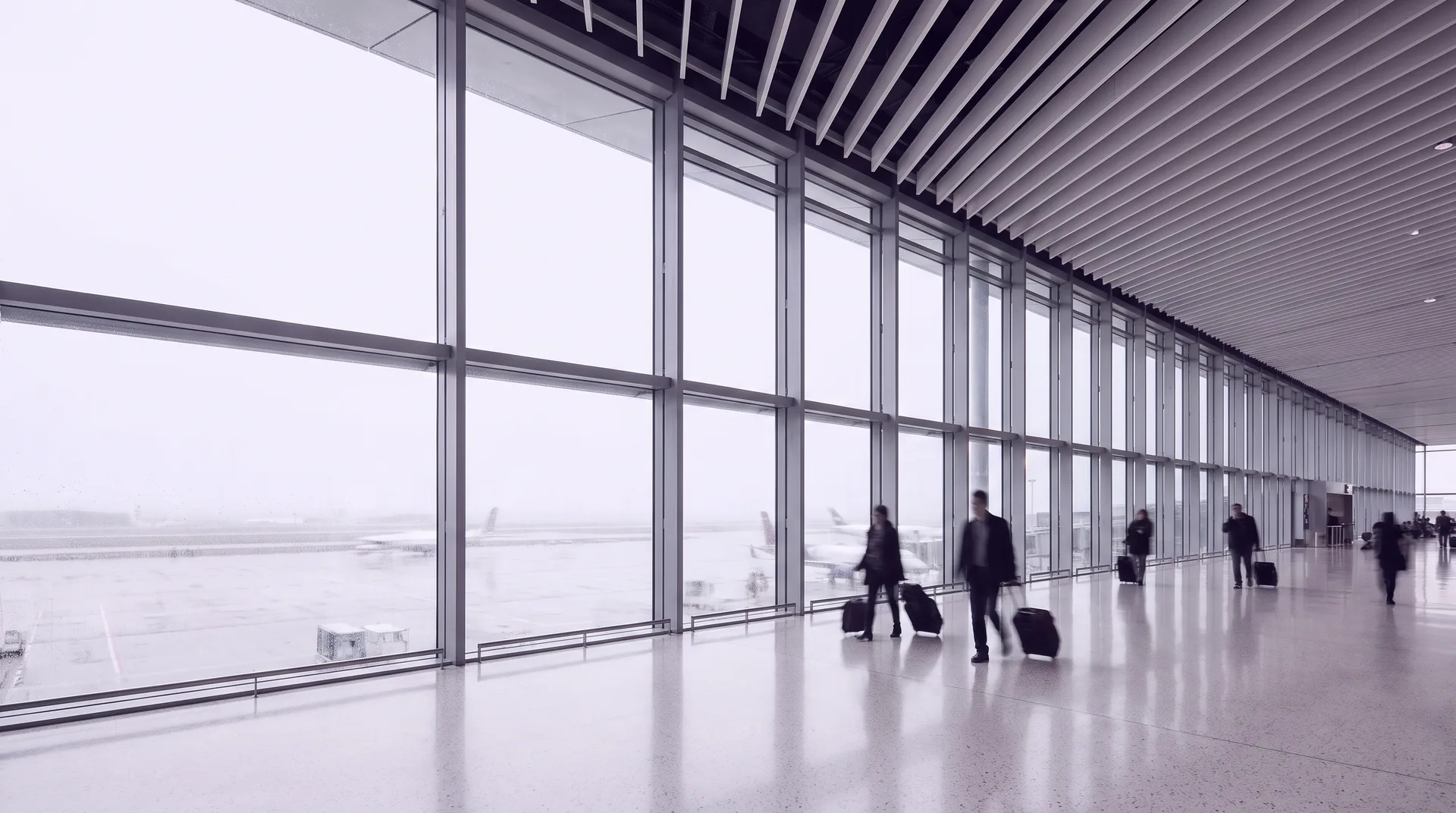
Dublin Airport
Dublin Airport (DUB) Is Ireland's Busiest Airport, about 10 km North of Dublin City Centre. It Handled 36.4 Million Passengers in 2025 across Two Terminals, and Has No Rail Link
| IATA / ICAO | DUB / EIDW |
|---|---|
| Serves | Dublin, Ireland |
| Coordinates | 53.4287° N, 6.2621° W |
| Elevation | 242 ft |
| Number of Terminals | 2 Terminals |
| Airport Opening Hours | 24/7 except Christmas Day |
| Recommended Arrival Time | 2h Short-Haul, 3h Long-Haul |
| Official Website | dublinairport.com |
Dublin Airport at a Glance
Terminal 1 and Terminal 2 Stand Side by Side on One Campus. Terminal 2 Opened in 2010 with Pier E, 25 Departure Gates and the US Preclearance Facility, and Holds Aer Lingus, British Airways and the US Carriers; Terminal 1 Has Everyone Else, Ryanair Included. Airside a Single Corridor Links the Two
Is There Free WiFi at Dublin Airport?
Yes. Pick the 'Dublin Airport Wi-Fi' Network and Tap Connect on the Pop-Up — No Sign-Up, No Registration and No Charge. The Airport Upgraded the Service and Calls It Faster than Ever, Though Speeds Still Drop at a Busy Gate
Where Can I Buy a SIM Card at Dublin Airport?
Airport WiFi
| Connection Speed | Slow / Unstable |
|---|---|
| Cost | Free, Often Time-Limited |
| Activation Time | Login / Ads / Forms |
| Documents Needed | Yes (eMail / ID / Login) |
| Coverage | Only inside Airport |
| Security | Public Network (Risk) |
| Can Be Set Up before You Fly | No |
| Local Phone Number | No |
| Can Pay in Cash | Not Applicable |
| Where You Get It | At the Terminal, Once You Land |
Local SIM Card
| Connection Speed | Fast 4G/5G Speeds |
|---|---|
| Cost | Counter Price, Varies by Desk |
| Activation Time | Queue and Paperwork at the Desk |
| Documents Needed | Passport Often Required |
| Coverage | Works across Entire Country |
| Security | Private Secure Connection |
| Can Be Set Up before You Fly | No |
| Local Phone Number | Yes |
| Can Pay in Cash | Yes |
| Where You Get It | A Desk or Kiosk in the Terminal |
Roaming Options
| Connection Speed | Fast, Depends on Your Plan |
|---|---|
| Cost | Your Operator Rate, Can Be High |
| Activation Time | Instant Connection |
| Documents Needed | None |
| Coverage | Works across Entire Country |
| Security | Private Secure Connection |
| Can Be Set Up before You Fly | Yes |
| Local Phone Number | Keeps Your Own Number |
| Can Pay in Cash | No |
| Where You Get It | Already Active on Your Phone |
travelData.shop eSIM
| Connection Speed | Fast 4G/5G Speeds |
|---|---|
| Cost | Free Trial, Then from 3.99 $ |
| Activation Time | Instant Connection |
| Documents Needed | None |
| Coverage | Works across Entire Country |
| Security | Private Secure Connection |
| Can Be Set Up before You Fly | Yes |
| Local Phone Number | On Selected Plans |
| Can Pay in Cash | No |
| Where You Get It | Online, before You Leave Home |
Why Use eSIM Instead of Dublin Airport WiFi?
Skip the Login Portals — Land, Tap Once, and You Are on a Fast Private Connection That Keeps Working Far beyond the Terminal
Instant Connection
Get Online the Moment You Land — No Searching for WiFi, No Waiting, No Login Screens
Works beyond the Airport
Stay Connected across the Entire Ireland — From the Airport to Your Hotel, City Center, or Road Trip
No Public WiFi Risks
Avoid Slow, Unsecured Public Airport Networks & Stay on Your Own Private Mobile Connection Instead
Perfect for Travel Essentials
Use Maps, Book a Ride, Check-In to Your Hotel, or Message Instantly after Arrival
How to Get Internet at Dublin Airport
Get Connected Instantly after Landing — No Airport WiFi Needed
- 01
Choose Your DATA Plan
Pick the Best Option for Your Arrival at Dublin Airport
- 02
Install eSIM in One Tap
Activate Your eSIM Instantly with One Tap — QR Code Available as a Backup
- 03
Get Online Instantly
Start Using Internet Immediately at Dublin Airport
Best Way to Get Internet at Dublin Airport
Compare Free WiFi vs Mobile Data & Choose What Works Best for You
FAQs about Internet at Dublin Airport
Everything You Need to Know about Getting Online at Dublin Airport
Still Need Help?
Chat With Our Support Team 24/7 for Help With Compatibility, Installation, Activation, or Connection Issues
★★★★★ Travelers Around the World Rate Us 4.7/5 — 439771 eSIM Orders Delivered WorldWide
"I Used travelData.shop During My Trip to Japan and It Worked Perfectly From the Moment I Landed. Setup Took Less Than Two Minutes and the Data Speed Was Amazing!"
"Super Easy to Install and No Roaming Fees. I Stayed Connected Through My Entire Europe Trip Without Switching SIM Cards. Totally Worth It!"
"I Bought My Plan Online Before Traveling to Thailand. The QR Code Arrived Instantly, and the Connection Was Fast Everywhere I Went — Beaches, Cities, Even Remote Areas."
First Time at Dublin Airport? Here’s What You Should Know
Where Can I Park at Dublin Airport?
See Practical Airport Parking Options, Walking Time to Terminals, Typical Price Guidance, and Booking Tips before You Drive to the Airport
Terminal 1 Short Term Block A
- Typical Price
- €4 First Hour, €50 Daily Cap
- Location
- Directly Opposite Terminal 1, 450 Spaces
- Best For
- Drop-Offs and Very Short Visits
Terminal 1 Short Term Block C
- Typical Price
- €4 First Hour, €50 Daily Cap
- Location
- Multi-Storey beside Terminal 1, 1500 Spaces
- Best For
- Short Stays with a Pre-Booked Rate
Terminal 2 Short Term
- Typical Price
- €4 First Hour, €50 Daily Cap
- Location
- Multi-Storey beside Terminal 2, 1800 Spaces
- Best For
- T2 Departures and Meeting Arrivals
Express Red Long Term
- Typical Price
- €25 a Day Drive-Up
- Location
- On the Airport Campus, 8000 Spaces
- Best For
- The Closest Long-Stay Parking
Holiday Blue Long Term
- Typical Price
- €20 a Day Drive-Up
- Location
- On the Airport Campus, 8000 Spaces
- Best For
- The Cheapest Long Stay
T2 Surface Long Term
- Location
- Surface Car Park by Terminal 2, 270 Spaces
- Best For
- A Long Stay without a Shuttle
T1 Drop & Go
- Location
- Level 2 of Terminal 1's Car Park C
- Best For
- Handing over the Keys and Walking Off
T2 Drop & Go
- Location
- Level 3 of Terminal 2's Short Term Car Park
- Best For
- The Same Service on the T2 Side
Reduced Mobility Parking
- Location
- T1 Short Term Block B, T2 Short Term and Express Red
- Best For
- Disabled Parking Permit Holders
What Facilities Does Dublin Airport Have?
Lounges at Dublin Airport
From €40 per Adult at Reception, and Priority Pass, DragonPass and BA Passengers Get in When There Is Space
Pay in from €35 per Person Online or €45 at Reception, Two Hours Maximum Stay
Pay in from €39 per Adult Online or €55 at Reception, Two Hours Maximum Stay
Pay in from €45 per Person Online or €55 at Reception, Two Hours Maximum Stay
The Phoenix Lounge
The Martello Lounge
The Liffey Lounge
The 51st & Green Lounge
Lounges, Food, ATMs and Storage
Check Practical Terminal Services While Waiting, Arriving or Departing: Food, ATMs, Storage, Charging, Accessibility Support and More
Where Can I Sleep at Dublin Airport?
Find On-Airport and Nearby Hotel Options, How to Reach Them from Arrivals, Expected Nightly Rates, and Practical Booking Tips for Late Arrivals or Early Departures
Clayton Hotel Dublin Airport Central
- On the Grounds of Dublin Airport
- Walking to the Terminal
Maldron Hotel Dublin Airport
- On the Dublin Airport Campus
- A Very Early Departure
Clayton Hotel Dublin Airport
- A Room with Long-Stay Parking
Holiday Inn Dublin Airport
- Just Off the M50, North of the City
- A Layover or a Night before an Early Flight
How Do I Get from Dublin Airport to Dublin?
Bus & Train at Dublin Airport
See Exact Route Options, Departure Points, Schedule Windows and Ticket Tips for Getting to the Center after Landing
Bus Connection
Dublin Express 782 to the City Quays
Dublin Express 784 to Trinity College and the Docklands
Aircoach 700 to O'Connell Street and Leopardstown
Aircoach 700X Express to the City Centre
Dublin Bus Route 16 to the City Centre and Ballinteer
Dublin Bus Route 41 to Lower Abbey Street
Taxi, Ride Apps and Car Rental
Compare the Main Door-To-Door Options after Landing, Including Official Taxi Pickup Points, Ride-Hailing Availability and On-Airport Rental Counters
Regular Taxi
- Official Operators
- Licensed Irish Taxis at the T1 and T2 Ranks
- Pickup Point
- Taxi Ranks Directly outside Terminal 1 and Terminal 2 Arrivals, with Dispatchers on Hand
- Payment Methods
- Every Fare Is Set by the Taximeter and You Are Owed a Printed Receipt
Ride Apps
Free Now
Uber
Bolt
Car Rental
Europcar
- Car Rental Desks in the Arrivals Halls of Terminal 1 and Terminal 2
- Follow the Terminal Signage to the Europcar Desk
- Phone Line Mon-Fri 08:00-18:00, Sat-Sun 09:00-16:00
Sixt
- Car Rental Area of the Arrivals Hall in Both Terminal 1 and Terminal 2
- Turn Right Out of Customs in T1, Straight Ahead in T2
Avis
- Arrivals Hall in Terminal 1, Multi-Storey Car Park at Terminal 2
- Head for the Avis Counter in the Baggage Claim Area
- Daily 05:00-23:30
Frequently Asked Questions about Dublin Airport
Travel Tips & Essential Information for Ireland
Ireland Is Small, Green and Easy to Travel, but Two Things Catch Out Arrivals from Mainland Europe — It Is an EU Member but Not Part of Schengen, so There Is Passport Control on Arrival, and Traffic Drives on the Left. Distances Are Short and the Weather Is Not

Official Languages: Irish, English
Irish Is the National and First Official Language under the Constitution and English Is the Second, but Daily Life Runs in English Almost Everywhere. Irish Comes First on Road Signs and Is Still a Community Language in the Gaeltacht Areas of the West and South-West. No Visitor Needs a Word of It
Mobile Network: 4G Reaches Almost the Whole Population and 5G Covers the Cities and Larger Towns, but Coverage Genuinely Fails in Parts of the West, in Mountain Valleys and Out on the Islands. The 3G Networks Are Being Switched Off, so a Handset without 4G Will Still Make Calls over 2G but Will Get Little Usable Data
Roaming/SIM/eSIM: An eSIM Is the Quickest Route on a Compatible Phone, Because It Activates before You Land and Needs No Shop Visit or Paperwork. A Local Physical SIM Can Work Out Cheaper on a Stay of Several Weeks and Gives You an Irish Number, Which Some Booking Sites Still Require. Roaming Often Costs Nothing Extra on an EU or UK Plan, so Read Your Own Terms First, and for Everyone Else It Is the Priciest Option. Download Offline Maps before You Head West, Whichever You Pick
Cards and Contactless Work Almost Everywhere, Including Small Pubs and Rural Shops, and a Good Number of Places No Longer Take Cash at All. Two Exceptions Are Worth Knowing. Dublin Bus Is Exact Fare in Coins and Gives No Change, so a TFI Leap Card Is the Practical Answer, and Plastic Bottles and Cans Carry a Refundable 15 or 25 Cent Deposit Added at the Till
Tipping Is Welcome and Never Expected. In a Restaurant with Table Service, 10 to 15 Percent Is the Normal Range for Good Service, and You Add Nothing Further When a Service Charge Already Appears on the Bill. A Drink Bought at the Bar in a Pub Carries No Tip at All, and Taxi Fares Are Usually Rounded Up. Since December 2022 Every Venue Must Display How It Shares Out Tips and Service Charges
Plug Type: Type G
Voltage: 230 V, 50 Hz
Adapter: Ireland Uses the Same Rectangular Three-Pin Type G Plug as the United Kingdom, so Anything from Mainland Europe Needs an Adapter. Supply Is 230 Volts at 50 Hertz, Which Almost Every Modern Charger Handles, but a Device Built Only for 100 to 127 Volts Needs a Converter and Not Just an Adapter
Ireland Is among the Safer Countries in Europe and Most Trips Pass without Incident. The Real Risks Are Pickpocketing in Central Dublin and on Busy Transport, Theft from Parked Cars at Trailheads and Viewpoints, and the Coast Itself, Where Cliff Edges, Rogue Waves and Fast Weather Injure More Visitors than Crime Does
- Dial 112 or 999 Free from Any Phone for the Garda, Ambulance, Fire Service or Coast Guard
- Traffic Drives on the Left and Limits Are in Kilometres per Hour, While Northern Ireland Uses Miles
- Rural Local Roads Dropped from 80 to 60 Kilometres per Hour in 2025 and Are Narrow, Walled and Winding
- The Drink-Driving Limit Is 0.05 Percent Blood Alcohol, and 0.02 Percent for Learner and New Drivers
- Never Leave Bags or Luggage Visible in a Parked Car, Including at Cliff Walks and Beauty Spots
- Stay behind Cliff Barriers, Keep Off Wet Rock and Never Turn Your Back on the Atlantic Swell
- Carry a Waterproof Layer All Year, Because a Clear Morning Can Be Horizontal Rain by Lunchtime
- Tap Water Is Safe Almost Everywhere, Though Local Boil-Water Notices Are Issued a Few Times a Year
Do
- Do Apply for a UK ETA before Any Day Trip North to Belfast or the Giant's Causeway
- Do Buy a TFI Leap Card, Which Beats Cash on Dublin Buses, Trams and City Rail
- Do Book Accommodation Months Ahead for Summer and Festival Weekends
- Do Allow Far More Driving Time than the Distance on the Map Suggests
- Do Pack a Rain Shell and Shoes That Cope with a Wet Field
- Do Bring Bottles and Cans Back to a Shop Machine to Reclaim the Deposit
Avoid
- Do Not Assume a Schengen Visa Admits You, Because Ireland Runs Its Own Visa System
- Do Not Expect Euro to Be Accepted in Northern Ireland, Which Uses Pound Sterling
- Do Not Count on a Credit Card to Waive Rental Car Damage Cover Here
- Do Not Rely on a Mobile Signal on the West Coast, the Islands or Mountain Roads
- Do Not Describe Ireland as Part of Britain or the United Kingdom
- Do Not Drive after a Drink, Because the Limit Is Low and Checkpoints Are Routine
Local Cultural Tips
- Conversation Is the National Sport, and Small Talk with a Stranger at a Bar or Bus Stop Is Normal
- Pubs Work as Living Rooms as Much as Bars, with Families, Food and Music, Not Only Drinking
- Drinks Are Bought in Rounds, and Everyone Takes a Turn, so Say at the Start If You Would Rather Not
- A Traditional Music Session Is a Performance, and Talking over the Players Marks You Out Fast
- Slagging Is Affection Rather than Insult, and the Best Reply Is to Give Some of It Back
- Ireland and Northern Ireland Are Different Countries with Different Currencies, and It Is Not Pedantry
- Say Hello to the Driver as You Board a Bus and Thank Them as You Step Off
- Queue Properly and Wait to Be Served Rather than Pushing to the Front at the Bar
- Keep Your Voice Down on Public Transport and in Guesthouses
- Ask before Photographing Musicians, Market Traders or Anyone Else at Close Range
- Go Carefully on History, Religion and Northern Ireland Unless Your Hosts Open the Subject
- Close Every Gate behind You on a Walking Route That Crosses Farmland
Get Online without Dublin Airport WiFi. Activate Your Free eSIM Trial When You Land
Get a Free eSIM Trial for Ireland When You Land at Dublin Airport, Then Continue with 1GB or Unlimited Data for Maps, Taxi Apps & Travel Essentials