
You hand over a card in a café in another country. The terminal thinks for a second, then asks a question you were not expecting: pay in the local currency, or pay in your own? One button is bigger than the other, there is a queue behind you, and you have about four seconds to decide.
That question is worth money, and it is only one of three or four places where a foreign transaction gets priced. This article takes the chain apart: who sets the exchange rate, who adds what on top, what the screen in front of you is obliged to show, and the habits that keep the difference in your pocket. None of it needs a special card or any arithmetic at the till.
Key takeaways
- Always choose the local currency. The other button hands the exchange rate to a company you did not pick and cannot compare.
- The rate and the mark-up must be on the screen before you confirm — under card network rules and, in the EU, under law.
- Your bank's own fee is chosen months before the trip, not at the counter. Look it up once.
- Cash is the expensive route: one withdrawal can carry up to four separate charges.
The Price Is Decided Three Times, Not Once
A card payment abroad looks like one event and is really a relay. Three companies touch the amount before it reaches your statement, and each can add to it. Almost everything travellers get wrong here comes from imagining a single price set by a single party.
| Who | What they decide | You decide |
|---|---|---|
| Terminal or cash machine | Whether to convert here, at their own rate | At the till |
| Card network | The wholesale rate, if nobody converted first | Never |
| Your own bank | The fee added for a foreign currency | Before the trip |
Only the first and the last are yours. The middle one is out of your hands and happens to be the cheapest, which is the whole argument of this article in one line.
Layer One: The Terminal Asks a Question
The offer to pay in your own currency has a name: dynamic currency conversion. It is a service sold by whoever supplied the merchant's terminal, with the margin shared with the merchant. That is why it exists, and why it is presented so warmly.
Here is the counter-intuitive part. Accepting does not avoid a conversion — nothing can, because you hold an account in one currency and the shop banks in another. It moves the conversion to the terminal's provider, the one party in the chain whose rate you cannot check beforehand. Your own bank then never sees a foreign currency at all: the transaction arrives already converted, with nothing left to compare it against.
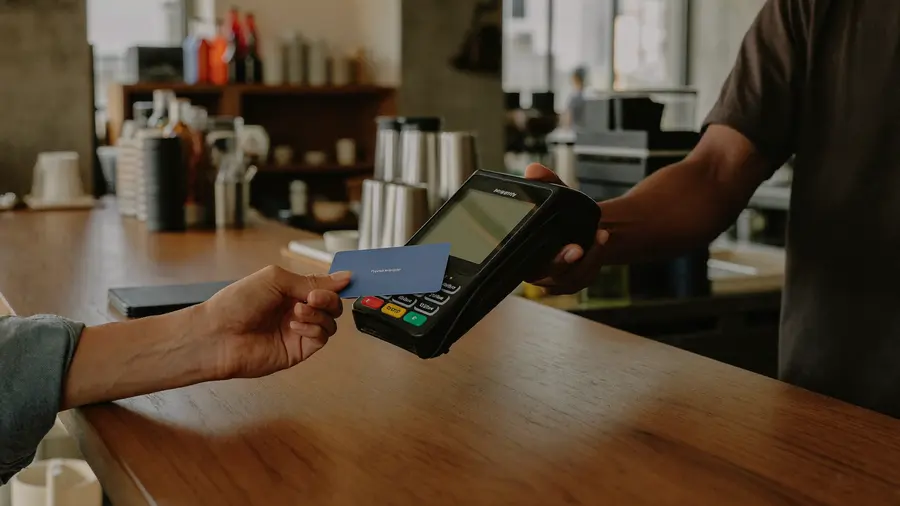
You are choosing whose exchange rate applies. One of them publishes its rates daily. The other is on the screen in front of you for four seconds and then gone.
The same question turns up where there is no card terminal at all: a foreign website with a currency selector already set to yours, a hotel bill settled at check-out, a hire desk closing a deposit. The mechanism is identical wherever an amount reaches you in your home currency from someone who is not your bank.
What the Screen Must Show You before You Press
This is the useful part, and hardly anyone knows it: you are not being asked to guess. What you need to answer properly is required to be on the screen.
Visa's guidance for cardholders is explicit. Merchants and cash machines "should give you a choice to accept or decline currency conversion and must not choose on your behalf", and where conversion is offered they must display the amount in both the local and your own currency, the exchange rate being used, and any additional fees or mark-up. Visa adds that they "should not use language or procedures such as different font size or color to influence your decision".
In the European Union this is not merely a network rule but law. Under the cross-border payments regulation, anyone offering currency conversion at a cash machine or at the point of sale must express the total conversion charges as a percentage mark-up over the European Central Bank's reference rate, and must disclose that mark-up before the transaction is initiated, alongside the amount payable to the merchant in their currency and the amount payable by you in yours. Those obligations have applied since April 2020, and the United Kingdom retained the same article after leaving the EU.
Warning
The rule says the presentation must be neutral. In practice the accept button is often the larger, greener, more central one and the decline is a plain line of text beneath it. Read the two amounts, not the button styling.
The honest case for declining is not that it wins on arithmetic every time. It is that declining leaves you with a known quantity: your network's rate is published and your bank's fee is in your terms. A terminal's mark-up is a number you meet once, under time pressure, with someone waiting.
Accepting the terminal's offer does not avoid a conversion. It replaces the one you could have checked with one you cannot.
Layer Two: The Card Network's Daily Rate
Decline, and the transaction travels onward in the local currency for the card network to convert. Visa sources its rates from the wholesale foreign exchange market and updates them daily for every currency pair. Mastercard applies either a government-mandated rate or a wholesale rate it selects, on the day the transaction is processed. Both publish a calculator, so a payment already made can be checked afterwards.
Two things here matter only so that neither is mistaken for an error: the rate is not the mid-market figure a search engine shows, which is an average nobody transacts at, and conversion happens at settlement rather than at the tap, so a Saturday purchase is usually priced on a weekday rate.
Layer Three: Your Own Bank, Decided Months Ago
After the network converts, your card issuer applies its own charge for a foreign-currency transaction. It goes by several names — foreign transaction fee, non-sterling or non-euro fee, currency mark-up — and varies enormously between two cards from the same bank, let alone between banks.
Note
The network's conversion and your issuer's fee are two separate charges from two different companies, and both can land on the same transaction. A card advertised as having no foreign transaction fee has removed the second one only.
This layer has the largest effect across a trip and is the only one you can do nothing about while travelling. Find the real figure in your card's terms, not on the marketing page, which tends to describe the best case.
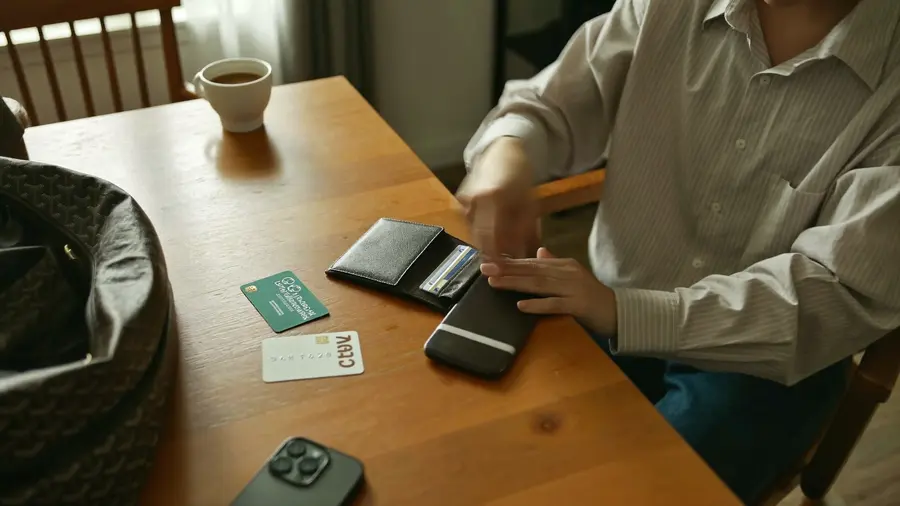
Looking up one number and packing a second card from a different bank is worth more than every clever decision you will make at a counter for the rest of the trip.
Cash Adds a Fourth Layer, and Sometimes a Fifth
Everything above applies at a cash machine too, with extra charges available only there. A single withdrawal can carry four:
- The machine's own surcharge. Set by whoever operates it, not by your bank. Machines in the wall of a bank branch tend to charge little or nothing in their home market; free-standing ones in airports, stations and tourist strips are commercial operations, and that is where the surcharges are.
- Conversion at the machine. The same offer as the café terminal, under the same disclosure rules, with the same answer.
- Your bank's foreign withdrawal fee. Often a percentage with a minimum, which punishes small withdrawals hardest.
- Cash advance charges, if you used a credit card. This is the one that surprises people.
Warning
Taking cash out on a credit card is not a purchase, it is a cash advance. There is normally no interest-free period, so interest accrues from the day of withdrawal, usually at a higher rate than the card's purchase rate, on top of an advance fee — and paying the statement in full does not undo it. Use a debit card for cash.
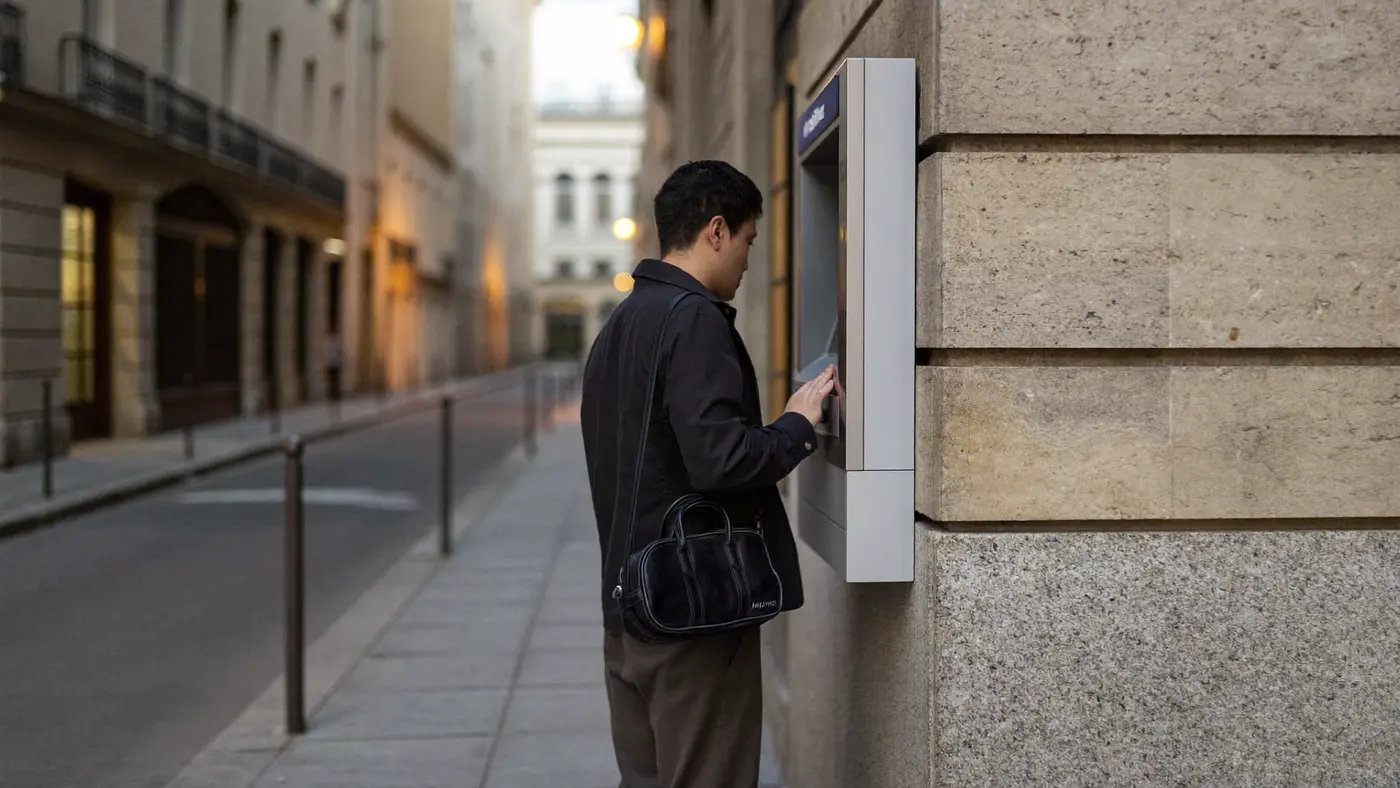
The practical shape of it: where a flat surcharge applies, withdraw less often and in larger amounts.
Six Things That Catch Travellers Out
- The website that has already decided for you. A foreign shop showing prices in your currency by default is doing what the terminal does, with a dropdown instead of a button. Find the selector before the payment step.
- The bill that is settled twice. A hotel or hire desk pre-authorises on arrival and settles the real amount at the end. Two events, and the conversion question can be asked again on the second.
- The refund that comes back smaller. A refund is converted again at the rate on the day it is processed, and fees on the original purchase are usually not returned with it. Short is normal, not an error.
- The hold that is bigger than the bill. Fuel pumps, hotels and hire desks reserve more than the expected total. It releases on its own, in days rather than hours.
- The card with no fees that has a fee somewhere else. The claim almost always covers purchases only. Withdrawals, a monthly allowance that runs out, or weekend transactions can be treated differently in the same document.
- The card that stops working on day two. Some issuers still flag a first transaction in an unfamiliar country. A second card from a different bank, kept somewhere other than your wallet, makes that an inconvenience rather than an emergency.
What to Do before You Fly
-
Look up your card's foreign transaction fee
In the terms, not the marketing. Check the withdrawal fee separately — it is frequently a different number.
-
Pack a second card from a different bank
On a different network too, if you can, and carried separately from the first. The cheapest insurance on this list.
-
Turn on instant transaction alerts
A notification for every payment is how you notice a conversion you did not agree to on the day, not on next month's statement.
-
Check whether your bank still wants a travel notice
Many have dropped it. The ones that have not are the ones that will decline a payment on your first evening.
-
Decide your cash number
Roughly what the trip needs in notes, so it comes out in one or two withdrawals rather than seven small ones.
What to Do at the Till
Do
- Choose the local currency — every terminal, every machine, every time.
- Read the two amounts and the mark-up. The rules exist so that you can.
- Use a machine attached to a bank branch when you need cash.
- Check the alert on your phone before you leave the counter.
Don't
- Accept your own currency because that button looks like the default.
- Take cash out on a credit card unless there is genuinely no alternative.
- Assume a card with no purchase fee also has no withdrawal fee.
- Make repeated small withdrawals where a flat surcharge applies.
Common Questions
Is Paying in the Local Currency Always Cheaper?
Not as a law of physics, but as a working rule it holds. Declining gives you the network's wholesale rate plus a fee you can look up in advance; accepting gives you a rate set by a company you have no relationship with. Occasionally the screen says otherwise, which is exactly why those numbers must be there — but the four-second default is the local currency.
What if I Pressed the Wrong Button?
If the payment has not gone through, ask for it to be cancelled and run again — staff do this routinely. Once it has settled there is generally nothing to reverse, because the conversion was a service you agreed to, however briefly.
Does This Apply to Online Purchases from a Foreign Shop?
Yes, and it is easier to handle because nobody is waiting. If the site has a currency selector, set it to the merchant's own currency and let your card convert. If it only ever offers yours, the conversion is happening at their end and the price on the page is what you pay.
Are Multi-Currency Accounts and Travel Cards Worth It?
They can be, and the reason is worth understanding rather than taking on trust. They mostly work by removing layer three, the issuer's fee, and sometimes by letting you convert at a moment you choose instead of at settlement. They do not touch layer one: a terminal will still offer to convert for you, and the answer is still no.
Does Any of This Apply to Buying a Travel eSIM?
It applies to anything priced in a currency that is not your card's, which is why this site lets you switch the currency yourself before you reach the payment step rather than deciding for you. The same principle, one layer earlier.
The Short Version
Before you go, find one number — your card's foreign transaction fee — and pack a second card from a different bank. On the trip, choose the local currency every time you are asked, use a bank's own machine for cash, and never take cash out on a credit card. That is the whole method, and it beats any amount of cleverness at the counter.
The trip is easier still if the phone works when you land. If connectivity is on the list, see what a plan costs for where you are going, work out how much data you need, and read how an eSIM works if it is your first.
Check prices for your destination in your own currency Switch the currency before you pay, so nobody else gets to choose the rate.