
The question everybody asks before leaving is which country. The question that decides whether the year works is much smaller than that: which room, at nine in the morning, five days a week. For the first fortnight it does not come up, because everything is new and any table with a view is a good table. Then the novelty wears off and you start noticing the chair.
This is about the room rather than the country: what a café can and cannot sell you, what a day pass buys once you look past the desk, what a week at a dining table does to your shoulders, and where a call can happen without shouting. The connection is a separate problem with its own failure drill, and a companion article covers what a working setup has to survive. This one assumes the line works and asks where you sit.
Key takeaways
- A café is a two-hour room — its furniture, its sockets and its economics all say so, whatever its Wi-Fi says.
- A day pass sells a chair, a door and a network; the desk is the least valuable thing in it.
- Booths and meeting rooms are what run out, so ask for the ratio and the rule, not whether they exist.
- Test a room for one hour at the hour you actually work, then buy a week — never a month off a midday tour.
A Café Is a Two-Hour Room
A café is not being unfriendly when it stops working for you at the ninety-minute mark. It is a room built around turnover, and every part of it is designed for a visit rather than a shift. The chair has a slat where a back support would be. The seat height is fixed to the table height, the table height is set for eating, and neither adjusts — so your elbows ride above your wrists and your shoulders come up to meet them without ever announcing that they have.
The sockets settle it. In most cafés they run along one wall, which means the workable seats are a small fixed number and they were taken at eight by people who understood this before you did. What you get instead is the seat by the door, at a table the right height for a cup and the wrong height for a keyboard, with the grinder two metres away. Somewhere around the second hour you start working badly and the room starts filling with people who want the table for the thing it is for.

The Etiquette of Occupying a Table
The unwritten rule is simple enough to state: order on a clock, not on thirst. Roughly one thing an hour is the going rate for a seat, and it is cheaper than any other room in this article. Take a two-seat table rather than the four-top by the window, because the four-top is the one the staff need at one o'clock. And when there is a queue at the counter and you have been there three hours, that is the signal.
Where service is part of somebody's wage rather than a bonus on top of it, a long stay is a longer shift for the person working it, and what is expected varies by country far more than most travellers assume. A café that posts a laptop-free hour is being kinder than one that does not, because at least you know. It is not aimed at you personally.
Do
- Order again roughly every hour you stay.
- Take the smallest table that fits you.
- Step outside or leave entirely to take a call.
- Leave when the room fills, and come back later.
Don't
- Hold a four-seat table alone through lunch.
- Unplug the room's own lamp for a socket.
- Spread across two tables with a bag and a coat.
- Treat one coffee as a day rate.
What a Day Pass Buys beyond a Desk
The desk is the least valuable thing a coworking pass sells. What you are buying is a chair whose height moves, a socket that belongs to your seat, a room where typing for eight hours is normal behaviour so nobody is waiting for you to leave, a door that closes behind you, and somewhere a parcel can be delivered while you are out.
The guest network is the part that reads well on the tour and disappoints on a Wednesday: one shared name, one captive portal, and everyone on the floor behind it at the same hour. The way most people stop caring about that is to stop depending on it and carry a connection of their own for the country they are in, so the room's network becomes the convenience rather than the lifeline.
| What you assume | What to ask |
|---|---|
| A desk | Any free seat, or only the hot-desk zone? |
| A full day | When does the pass start and end, and can you leave and come back? |
| Meeting rooms | Included outright, credited by the hour, or billed? |
| Phone booths | How many, for how many seats, and are they bookable? |
| The network | One guest name for the whole floor, or a members' network? |
| Storage | Is there a locker, or does the bag come to lunch with you? |
Booths and Meeting Rooms Are What Run Out
Every space has booths. The number that matters is how many, against how many seats sold — and it is never on the website. A floor selling a hundred day passes with three booths has a queue on every hour boundary, because calls start on the hour and end on the hour, and everyone discovers this at five to eleven.
Ask whether the booths can be booked, and understand that both answers cost something. A bookable booth is one you cannot simply walk into when a call moves; an unbookable one is a booth somebody has been living in since nine. Ask whether there is a cap per person per day. On meeting rooms, "included" is almost always credits, credits usually reset monthly, and a day pass frequently carries none at all — so the room exists, and it is not yours.
The Desk in a Flat Is a Dining Chair
The listing photograph shows a desk. What is in the room is a dining table, a hard dining chair, and on a bad day a bed. The problem is not comfort, it is that none of the three heights can move. The screen sits well below your eye line, so your neck holds your head forward all day. The chair has nothing at the lower back, so you round into it by the afternoon. The table is set for eating, so your shoulders lift to reach the keyboard and stay there. None of it hurts on day one, which is exactly why by day five you are tired in a way that has nothing to do with the work — and easy to blame on the country, the time difference or yourself.
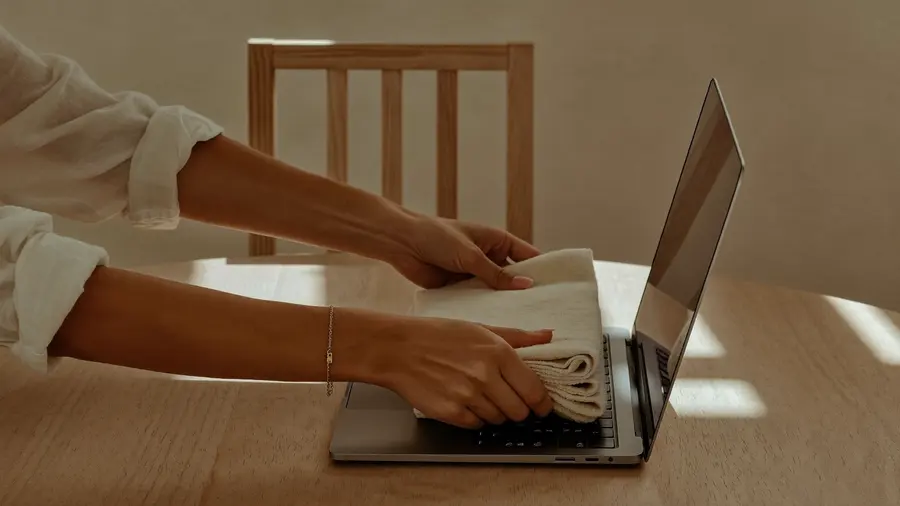
Raise the screen on anything solid, raise yourself on a cushion until your elbows meet the table, and put the suitcase under your feet once they no longer reach the floor.
Do that and the keyboard is suddenly in the wrong place, because a laptop cannot put the screen at eye level and the keys at elbow level at once. A separate keyboard is the one piece of equipment worth the weight in a bag. The rest is behavioural: stand up every three quarters of an hour, and treat the flat as somewhere you work for part of the day rather than all of it.
The Reading Room Nobody Considers
Public libraries are the option that almost never comes up, and they are better at one specific job than anything else on this list. They are central, they cost nothing, the silence is enforced rather than hoped for, and the staff are employed to help strangers find things. Most large city libraries now have a study floor with proper desks and power at the seat, which is precisely the thing a café cannot sell you at any price.
University libraries vary more. Some are card-only, many run a visitor or reader's pass by the day or the term, and a surprising number of faculty reading rooms admit anyone who walks in during term. Ask at the front desk rather than reading the website, which is written for enrolled students and tends to describe the strictest version of the rules. National libraries usually issue a reader's card to anyone with identification and an address, sometimes the same day.
The trade is real, so make it deliberately. No calls at all. Often no drinks. A bag locker at the door, and a closing time that is early and non-negotiable. That makes a reading room the right place for the three or four hours of work that need concentration, and the wrong place for a day that contains meetings.
Where You Can Take a Call
The two ways a call goes wrong are not the same problem. Shouting means you are too loud for the room you are in. Apologising means the room is too loud for the call. A booth solves both, a bedroom solves most of it, a stairwell or a corner of a hotel lobby solves one at a time, and a busy café solves neither.
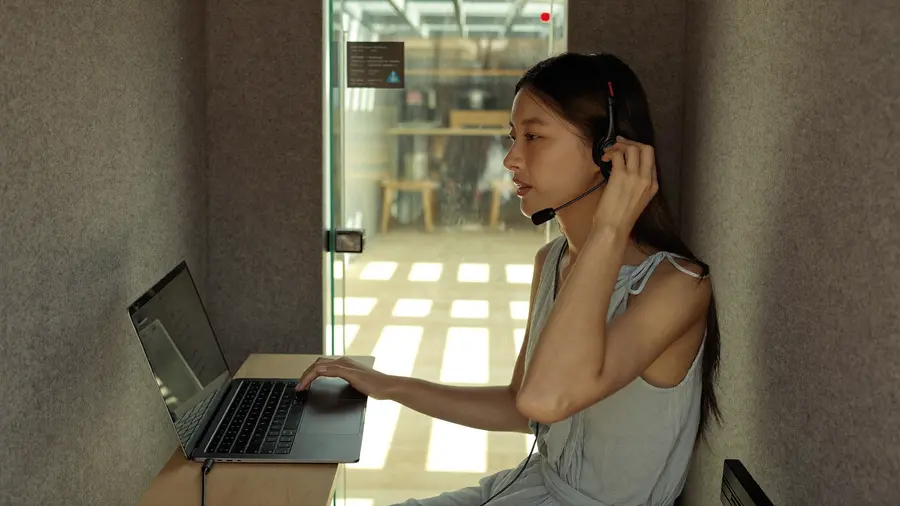
It is a small room with soft walls, which is the only thing that reliably fixes how you sound to the other end of the call.
Two things ruin more calls than bandwidth does, and both are properties of the room. Wind is the first: a microphone in moving air is unintelligible on a perfect connection, which is why the park bench that looks ideal is not. Hard surfaces are the second — a tiled bathroom puts a cave behind your voice, and a bed or a coat over a chair back fixes it for nothing. A headset with a boom is the cheapest improvement available, because it puts the microphone in the same place whatever the room is doing.
What the room cannot fix is losing the network mid-sentence, and a call is the one task that cannot simply wait for the Wi-Fi to come back. A data plan that lives on the phone alongside the home line — which is what an eSIM is — means the fallback is already there rather than something to arrange while forty people wait.
Test a Room in an Hour, Not a Month
Nobody would buy a month from a five-minute tour, and almost everybody does. The tour happens at eleven on a Tuesday, when the room is at its emptiest and quietest and the person showing you round is the friendliest human in the building. An hour of your own, at the hour you actually work, tells you more than any of it.
-
Sit where you would really sit
Not the seat you were shown. Take a plausible one, on an ordinary day, and stay in it.
-
Count the sockets you can reach
From that seat, without a cable across a walkway. Sockets on the far wall are somebody else's.
-
Work a real hour at your real hour
If your day starts at four in the afternoon, the room at four in the afternoon is the only one that matters.
-
Take one genuine call
Then ask the person on the other end what they could hear behind you. They will tell you things the room will not.
-
Stay through the peak
The lunch rush in a café, the hour boundary in a coworking space. A room is only as good as its worst forty minutes.
Then buy a week. A week is long enough for the room to stop performing and cheap enough to walk away from, and it is the single best purchase in this whole article.
Two Rooms and a Fallback
The arrangement that survives a long stay is not one perfect place. It is two rooms and a fallback: somewhere silent for the work that needs concentration, somewhere with booths and other people for the calls and the days you need company, and the flat kept merely usable for the evening and the emergency. Rotating is not restlessness. It is refusing to ask one room to do three different jobs, which is the thing every single-venue plan quietly does.
One last note. If the stay stretches from weeks into months, where you work starts to matter to more than your shoulders — the rules on residence are not the ones most people think they are.
Sort the connection before you pick the room See what is available where you are heading, so the room is the only thing you still have to choose when you land.Common Questions
Is a Day Pass Worth It for a Single Day?
For one day of ordinary work, rarely — a café and a library between them cover it for less. It becomes worth it the moment the day contains calls, because you are buying a booth and a room where speaking aloud is normal, not a desk. Buy the day pass on the day with meetings in it.
Can I Work from a Hotel Lobby?
For an hour or two, often yes, and the seating is usually better than a café's. The limits are that lobby Wi-Fi is shared with every guest and every guest's family, and that lobbies are designed to be sociable, so the noise floor moves without warning. Treat it as a good waiting room rather than an office.
What if the Flat Is the Only Quiet Place?
Then fix the geometry rather than accepting it. Raise the screen, raise the seat, support the feet, add a separate keyboard, and put a soft surface behind you for calls. Leaving the building at least once during the working day matters more than most people expect, even if only to a café for the hour that does not need a desk.
How Do I Find These Rooms before I Arrive?
Map the shortlist rather than booking it. Find the central public library, one or two coworking spaces with published day rates, and a café that opens early, all within walking distance of where you are staying. Then buy nothing until you have sat in them. Committing to a monthly desk from another country is how people pay for a room they never use.