
For twenty-five years, changing mobile networks ended the same way: a small metal tray, a bent paperclip, and a card the size of a fingernail pushed into a slot on the side of a phone. It was the one part of the mobile industry a traveller could hold. On a growing number of handsets, that hole in the side of the phone is simply not there any more.
Removing the tray moves the act of joining a network out of the physical world and into a server, and that single change reaches further than it looks — to what a traveller can do in an arrivals hall, what happens when a phone goes in for repair, and what the handset is worth when it is sold. Here is the mechanism, and why it has spread so unevenly.
Key takeaways
- The chip never left. It was soldered down. What was removed is the ability to move it by hand.
- The eSIM-only list is a list of countries, not of models. The same phone name ships with a tray in one market and without one in another.
- A tray comes out only where the whole system around it — networks, shops, identity checks, resale — can already work without plastic.
- A profile has to be downloaded, so it needs a connection. That is the one genuinely new dependency at a border.
- Repairs and resale both gained a step that used to be a pocket.
What the Tray Was Actually For
The plastic card was never the phone's connection to a network. It was a secure element: a tiny, tamper-resistant computer holding the credentials that prove this device is entitled to a particular number. The network never cared what shape it came in.
What the tray gave the world was portability. The secure element could be handed across a counter by somebody who knew nothing about you, moved into a different phone in seconds, and swapped back. An eSIM keeps the secure element and solders it to the board. The credentials arrive as a download instead of as a card, which is the part our guide to what an eSIM is covers in full.
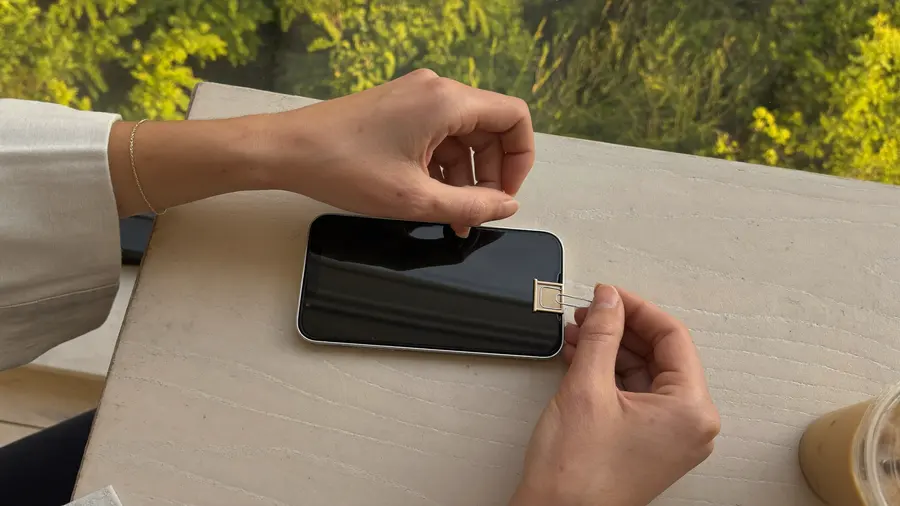
A tray, a paperclip and thirty seconds. It needed no account, no signal and nobody's permission, which is exactly what made it so easy to take for granted.
Nothing about the radio, the coverage or the network itself changed. What changed is who has to be involved in a swap: a shop assistant and a paperclip became a provisioning server, an account, and a working data connection.
Why It Started in One Market
The first mainstream handset to ship with no tray at all did so in a single country. Apple removed it from iPhone 14 models sold in the United States in 2022, while the same models sold everywhere else kept the slot. Nothing about the hardware was uniquely American.
2022
the year a flagship phone first shipped with no SIM tray, in one market only
The United States was simply the market where everything around the tray had already stopped needing it. Most phones there are sold by the networks themselves rather than bought outright and fed a card from a kiosk, every major operator already issued profiles remotely, and no rule obliged anyone to ship a slot at all. The tray came out where the surrounding system could do without it, and stayed in where it could not.
The List Is of Countries, Not of Phones
This is the durable part, and it is visible in the manufacturer's own documentation. Apple's support page on which type of SIM an iPhone uses is organised by where the phone was purchased, not by model number — the same name, the same box, different hardware inside depending on the market it was built for.
| The assumption | What decides it |
|---|---|
| The model name on the box | The market the phone was built and sold for |
| How new the phone is | Whether that market's networks and shops can already work without plastic |
| The country you live in | The country the phone came from, which is often not the same one |
| Your mobile network | The manufacturer, before the phone was ever put on a shelf |
Read on 28 August 2026, that page listed the eSIM-only build for a group of purchase markets well beyond the United States, while identically named models sold across Europe and most of Asia still had a tray. Any list of models and countries printed here would be wrong within a year. The shape of the list will not be: it is a map of retail systems, redrawn one market at a time.
What Has to Be True Before a Tray Comes Out
Four things, and the spread looks arbitrary only because all four are invisible to a buyer.
-
Every network a buyer might choose can issue a profile remotely
Not most of them. A phone with no slot is useless on an operator that cannot provision one, so the last holdout sets the pace for the whole market.
-
The retail channel can sell something that is not a card
Supermarket shelves, airport kiosks and street stalls are built around physical stock. Replacing that with a code is a change to thousands of small businesses, not to a phone.
-
Identity checks work without a counter
Much of the world requires an identity document before a mobile number is activated. Where it happened as the card was handed over, it now has to happen somewhere else.
-
The second-hand market can absorb the handset
A used phone is normally tested by putting a card in it. A market that resells heavily has a reason to keep the slot that a market trading phones back to its networks does not.
Where one of the four is missing, the tray stays. That is why the change arrives in one country years before its neighbour.
What an eSIM-Only Phone Does Better
The gains are real, and they are mostly a traveller's. Several profiles can sit on the phone at once and be switched in software, so a home number and a local one coexist without either being ejected and lost in a hotel-room drawer.
A plan can also be bought and installed at home, before the flight, which turns the first hour after landing from an errand into nothing at all — the sequence our installation walkthrough covers step by step. There is no card to lose, no tray to bend, and no paperclip to hunt for at an airport. A stolen phone is worth slightly less to a thief, too, because the number cannot be lifted out of it and dropped into another handset.
What It Cannot Do
The losses are narrower, but they are the ones that arrive at the worst moment.
- Borrow a line. A colleague's card in your phone for an hour is not something that can happen any more.
- Buy from a stall that only sells plastic. Plenty of counters, in plenty of countries, still stock cards and nothing else.
- Move the number into a borrowed handset in thirty seconds. That transfer now runs through the network, at the network's speed.
- Prove a used phone gets a signal with a card from your pocket. Buyer and seller both lose the thirty-second test.
One more catches people who did nothing wrong. A handset sold locked to a network stays locked: Apple's travel guidance states plainly that to use an iPhone with another carrier abroad, the iPhone cannot be locked to a carrier. That was equally true of a plastic SIM — it is simply far more visible once the slot is gone.
What Changes at a Border
One new dependency, and it is genuinely new: a profile has to be downloaded, and a download needs a connection. Apple's own instructions for using an eSIM abroad say the iPhone must be connected to a Wi-Fi network or a hotspot, with a narrow carve-out in some countries where an eSIM-only model can activate without one.
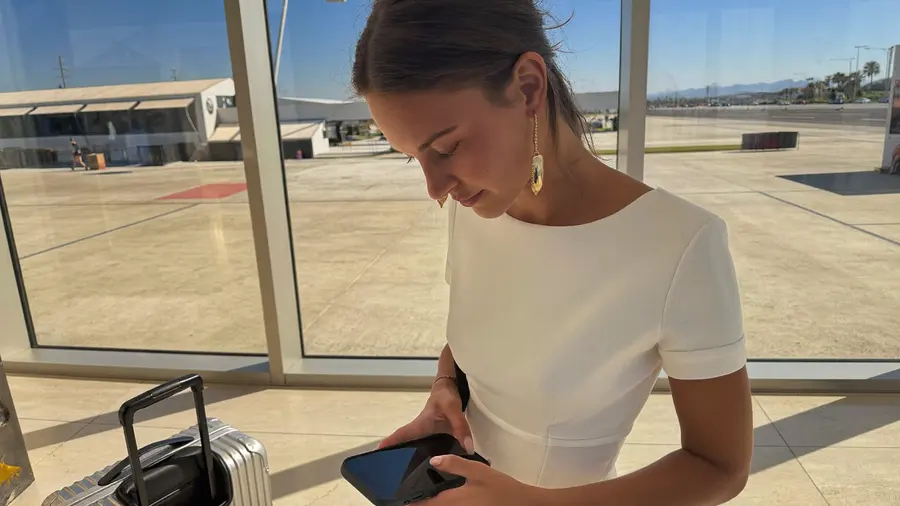
A plastic card worked the instant it was in the tray. A profile has to arrive over a connection you do not yet have, which is why it belongs on the phone before the flight.
Warning
Do not plan on buying connectivity after you land unless you know there is open airport Wi-Fi you can actually reach. Install before departure, and keep the activation details somewhere that is not the phone you are activating.
The identity side has changed less than people expect. In much of the world a local number has required an identity document for years, so walking out of arrivals with one was never universal. What is different is that the check can no longer be done by handing over a card, which is why a shop visit remains the local route in many places. A travel plan bought before departure is issued where it is sold rather than where you land, which sidesteps that queue — the route from buying to landing sets out in full.
What Changes at the Repair Counter
Two sentences from the same manufacturer's service page, sitting next to each other, describe the whole difference better than any commentary.
If your iPhone uses a physical SIM card, remove it and keep it in a safe place. If your iPhone uses an eSIM, contact your wireless service provider to suspend service.
Apple, on sending an iPhone in for service
One is a pocket. The other is a phone call to a third party, in their hours and in their language. The gap widens when the phone itself is the problem: transferring a profile to a replacement generally assumes the old device still works. Google's Pixel instructions for moving a SIM to a new phone ask for both devices to be set up and for the other one to be near — which a dead screen or a drowned board cannot manage.
Two things are worth doing before you hand a phone over. Find out how your network re-issues a profile, because that is the path you will be on. And note that a repair which replaces the main board replaces the embedded chip with it, so the profile has to be downloaded again afterwards.
What Changes When the Phone Is Sold
Selling a phone gained a step that is easy to skip and awkward to undo. Manufacturer guidance is to erase the device and the eSIM profile when the phone is going to somebody else, and Apple is blunt about the cost of doing that carelessly: if you erase an eSIM, you will need to contact your carrier to get a new one.

Two consequences follow. A seller who wipes the phone without thinking can erase a working line and spend a week getting it back. And a buyer loses the oldest test in the second-hand trade — a spare card, a bar of signal, done.
There is a quieter one as well. An eSIM-only handset carries its market with it: resold into a country whose networks do not issue profiles to strangers, it is an excellent camera and very little else.
Common Questions
Can I Still Buy a Local Prepaid Plan Abroad?
Often, but not everywhere and rarely at the airport counter. Where local operators issue profiles, the process runs through their app or website like any other eSIM purchase. Where they stock only cards, an eSIM-only phone cannot use them at all.
Does an eSIM-Only Phone Roam Normally?
Yes. Roaming is a relationship between your plan and the visited network, and a missing slot has nothing to do with it. What is different is your ability to opt out of roaming by buying something local on the spot, which is exactly the option a missing tray removes.
What Happens if the Phone Is Lost or Stolen?
The same first call as always: tell your network so the line is suspended. The profile cannot be pulled out and used elsewhere, which is a genuine improvement. Getting the number onto a replacement handset is a re-issue by your network rather than something you do yourself with a paperclip.
Can I Keep a Spare Phone as a Backup?
You can, but it is no longer instant. A second handset needs its own profile, either transferred from the first — which usually requires the first to be working — or issued fresh. Set one up while both devices are healthy, rather than at the moment one is not.
What to Do Before Your Next Trip
The tray is not being removed to make life harder. It goes in the markets that have already built everything it used to do, and stays in the markets that have not. For a traveller that comes down to one shift in timing, and four minutes with our device compatibility checker covers most of it.
-
Find out which build you are carrying
Look at the edge of the phone, not at the model name on the box. Purchase market, not model number, is what decides it.
-
Install before you fly
On home Wi-Fi, days ahead if you can. An eSIM-only phone with nothing on it is a phone with no way to get anything on it.
-
Keep the activation details off the phone
Printed, or on a second device. A code stored only on the handset it is meant to activate helps nobody.
-
Know your re-issue route
One search now, before the phone is broken, lost or wiped. It is the same answer for all three.
The connection you used to buy on arrival is now something you arrange before you leave — and once you have done it once, it is faster than the paperclip ever was.