Bangkok is the city first-time visitors most often call overwhelming, and very few of them can say afterwards what actually overwhelmed them. It is rarely the crowds and never the noise. It is that the city runs on three or four systems that never appear on the same map, and a visitor meets them one at a time, on foot, in heat that makes every wrong turn expensive.
So this is not a list of temples. It is the small number of decisions that separate a first two days which feel effortless from two days spent sitting in traffic: which airport you land at, which half of the city you sleep in, how you cross it, what your money lives on, and the handful of rules here that are enforced rather than merely mentioned.
Key takeaways
- Sleep near a station — the elevated lines are the only part of the city that traffic cannot reach.
- Two airports, two different entrances, and only one of them puts you on the rail network directly.
- Plan the day around the heat, not around distances. The middle of it belongs to shade.
- Carry cash. Thailand's own instant payments are a closed system that visitors cannot join.
Bangkok Has Two Halves and Only One of Them Has Trains
Bangkok has no loop and no grid. What it has is a corridor. Two elevated railways and a metro cut through the modern city, and anything within a few minutes' walk of them behaves like a different place from anything that is not. The modern half — the offices, the malls, most of the hotels — is threaded with stations and can be crossed at rush hour without noticing there is one.
The old royal quarter beside the river, which is where nearly every photograph of Bangkok comes from, is not. The metro now touches its edge at one point, but the quarter itself is walked, in full sun, between sights that are further apart than they look on a phone. That single asymmetry is why the choice of hotel matters more here than the choice of neighbourhood: a room on the corridor gives you the old city on a boat ride, while a room in the old city gives you the modern half at the mercy of the road.
Addresses follow the same logic: a main road and a numbered side street — a soi — with odd numbers down one side and even numbers down the other. A driver wants the road and the soi number, not your hotel's name.
The Airport Decides Which Half You Arrive in
Bangkok has two international airports and they sit on opposite sides of the city. The larger and newer one is east, and it connects straight into the rail network, so a train can put you inside the modern half without your ever touching a road. The older one is north, handles most low-cost flights, and its rail link is newer, runs to a different terminus and generally involves a change with luggage.
Neither is a bad arrival. The mistake is treating them as interchangeable while comparing fares, then discovering that the cheaper flight lands on the far side of the city from the bed you booked. Both have a marked public taxi rank, and both have people standing in front of it offering a fixed price instead. The way past that conversation is the app on your phone, which needs a working connection at the kerb — which is the argument for sorting out data before you fly rather than in an arrivals hall at midnight.
The Heat Is Your Timetable, Not the Opening Hours
Bangkok's day has a shape, and it is not the one printed on an attraction's website. Early morning is comfortable and almost empty. The middle of the day is genuinely punishing, and no amount of determination changes that. The evening is when the city is at its best and when most of it actually happens.
The seasons only change the details. Roughly March to May, heat is the entire story. From about June into October it rains — heavily, usually in the afternoon, and usually for about an hour rather than all day, so it reorganises a plan instead of cancelling it. November to February is the stretch people mean when they say Bangkok is lovely.
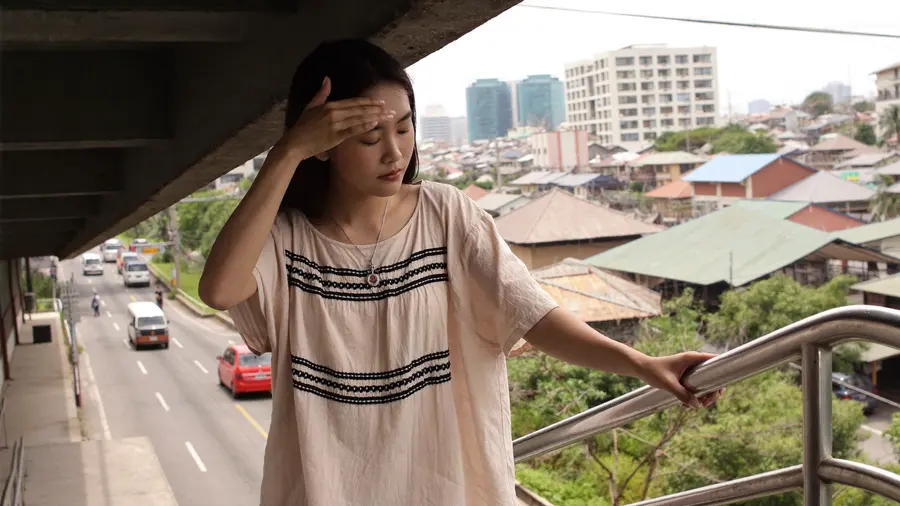
Go out early, spend the hours either side of noon somewhere with a roof, and come back out at five. A route that looks efficient on a map can be unwalkable at one in the afternoon.
The River Is a Bus Route, and the Road Is a Tax
The Chao Phraya is not scenery, it is public transport. Boats run up and down it all day and stop at piers the way a bus stops at a stop. They are identified by the colour of the flag on the stern rather than by a route number, and the flag is not decoration: a different colour means a different set of piers, and one of them skips almost everything in between. For the old city the river is usually both the fastest way in and the only pleasant one.
Everything else is a choice between rail and road, and the gap between them is enormous. The elevated and underground lines are quick, cold and completely indifferent to traffic; they are also two separate systems with separate gates, so a journey that crosses from one to the other is billed as two. The road is the opposite in every respect. A distance a map calls fifteen minutes can take an hour at the wrong point in the day, and there is no clever route around it.
| Mode | Best for | Catch |
|---|---|---|
| Rail | Crossing the modern half at any hour | Two systems, two fares |
| Boat | Reaching the old city and the river temples | Stops early in the evening |
| Taxi | Luggage, late nights, three or more people | Useless in traffic |
| Motorbike | The last stretch down a long side street | No luggage, no hesitation |
The motorbike taxis are the piece visitors overlook. Riders in numbered orange vests wait at the mouth of most sois and solve the last kilometre, which is exactly the stretch a hot walk ruins.

Thailand Went Cashless without Inviting You
Thailand runs on instant bank transfers made by scanning a code, and it runs on them everywhere — market stalls, taxis, temple donation boxes, the man selling fruit from a cart. It is also a domestic system: joining it needs a local bank account, so a visitor spends a fortnight watching a cashless country operate around them while paying in notes.
Cards fill part of the gap and not the interesting part: they work in malls, hotels and chain restaurants, and stop working at precisely the places you came here for. Cash machines add a flat charge to a foreign card on top of whatever your own bank takes, which makes several small withdrawals a worse deal than one large one. If a screen offers to bill you in your home currency, decline it — the reasoning is in our guide to paying abroad without losing money to fees.
What has to work across all three of those worlds is the phone: it is the map, the car, the translation of a handwritten menu and the camera that reads the code taped to a counter. Whether your handset can carry a second line alongside your own number is worth checking before you fly — a five-minute question at home, an awkward one in an arrivals hall.
What Gets You Turned Away, and What Gets You Fined
Travellers tend to run these together, and they are different problems. The first is dress. The major temples and the palace enforce covered shoulders and covered knees at the gate, on everybody, and enforcement means being sent back to rent a wrap and rejoin the queue. Feet are never pointed toward a Buddha image, which is why everybody sits with their legs folded to one side.
The second is law, and here the surprises are real. Electronic cigarettes and vaping devices are illegal to bring into Thailand, to sell and to carry, which visitors break constantly because the rule is unusual and nobody warns them. Shops may sell alcohol only inside legally set windows of the day, and not at all on several Buddhist holidays; those windows have been revised more than once, so check the current year rather than trusting this sentence. And disrespect toward the monarchy is a criminal matter here rather than a question of manners.
Do
- Pack one set of clothes that covers shoulders and knees, and wear it on temple mornings.
- Stand still if you hear the royal anthem played in a public space.
- Take your shoes off wherever you see a rack of them by a doorway.
Don't
- Bring a vape. It is illegal to carry, and it will be taken at the border.
- Touch anybody on the head, or step over someone sitting on the floor.
- Assume a shop can sell you a beer because it is open and has one in the fridge.
The Approach That Starts with a Helpful Fact
The most common approach in Bangkok is friendly, unhurried and dressed well, and it begins with information rather than with a sale. A stranger near a major temple mentions that it is closed this morning for a private ceremony and, since you have come all this way, knows a driver who will take you round three other places instead. Those places reliably include a gem shop or a tailor, and the tour does not end until you have stood in one.
Memorising the script is not much use because the script changes. The shape does not: somebody volunteers a fact you cannot check, the fact deletes your plan, and a solution is already waiting. The major sites do not close for a morning ceremony — walk to the gate and look.
Nobody who genuinely wants to help you will mind you walking to the gate to check.
Where to Eat, and How the Ordering Works
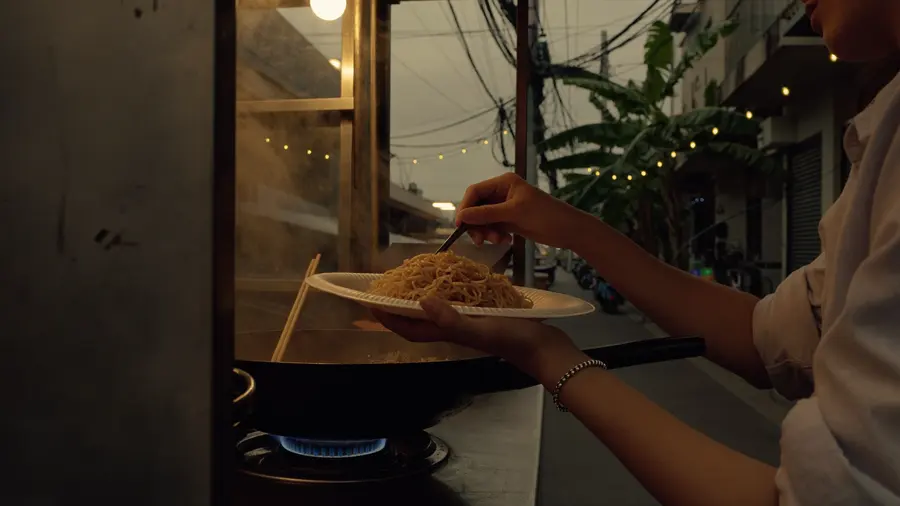
One cart, one dish, done several hundred times a day. Pointing is a completely normal way to order, and the queue in front of it is the review.
Street food is not the adventurous option in Bangkok, it is the default one, and the carts that specialise in a single dish are usually the ones worth queueing at. Order per dish rather than per person and share what arrives; that is how the food is designed to be eaten.
Two mechanics catch people out. Mild is a genuine option and is worth asking for on the first day, because the default here is calibrated for people who grew up on it. And many shopping-centre food courts do not take money at the stalls at all: you buy a stored-value card at a counter first, spend it around the hall and hand it back for whatever is left. Nobody explains this, and it looks like every stall is refusing you.
Three Days, in the Right Order
Spend the first day on foot in your own district, learning one station and one soi properly instead of six of each badly. Give the second to the river: boat down early, the old city before the heat arrives, and out of it by the time it does. Let the third go to whatever the first two made you curious about, which will not be the thing you planned.
The one job worth doing before you leave home is connectivity, because it sits underneath everything else here — the map, the car at the kerb, the menu you photograph, the claim you want to check at a temple gate. Doing it tired, in a queue, at an airport counter is the worst available version of a small task.
Data plans for Thailand See what the networks there actually offer, and land with it already working.Common Questions
How Many Days Should a First Visit Be?
Three full days is where Bangkok stops being a series of errands and starts making sense. Two works if you accept you are seeing one half of the city. Anything beyond four is usually better spent using Bangkok as the hinge it is, with a few nights somewhere else on either side of it.
Do I Need Any Thai?
No, though a phone that can translate a photograph of a menu changes what you eat. Signage on the rail network, at the airports and at the major sights is bilingual. Away from those, English thins out quickly, and politeness carries further than vocabulary.
Is Walking around at Night Reasonable?
Broadly yes, and the city is busy late, which helps. The realistic risks are traffic, uneven pavements and the fact that boats stop long before the bars do — so the journey home is a road journey, and worth thinking about before rather than after.
What Is Actually Worth Booking in Advance?
Your first two nights, your airport transfer if you land late, and your data. Almost nothing else needs it: restaurants, boats and most temples are walk-up. How much data a trip like this actually consumes is a question we have answered separately, and if Bangkok is one stop on a longer run, our destination pages cover the rest of it.