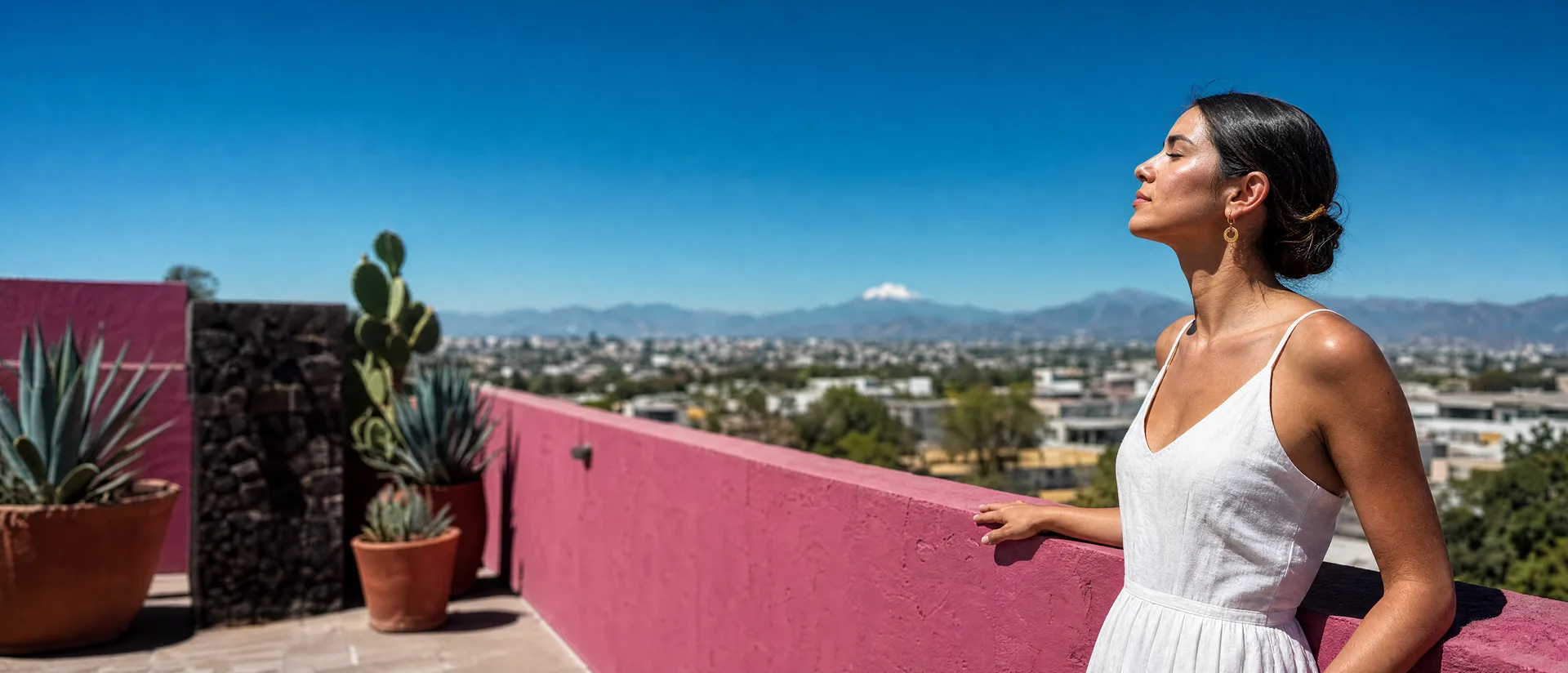
Most people arrive in Mexico City braced for the size of it and are caught out by something quieter. The city sits in a mountain basin a little over two thousand two hundred metres above the sea, and the first afternoon has a way of running long: stairs are work, one drink does the job of two, and the itinerary you wrote at home turns out to have been written for a city at sea level.
So this is not a list of sights. It is the handful of things that decide whether the first two days feel easy or expensive — what the thin air does to you, why the ground under the city behaves the way it does, how an address is actually built, which car you get into at the airport, and when people eat. None of it is difficult. Almost all of it is different from what you are used to.
Key takeaways
- Give the altitude a day — plan one neighbourhood for day one, not three.
- An address is incomplete without its colonia; the same street name repeats across the city.
- Both airport terminals are one airport in name only, and moving between them means leaving the building.
- The main meal is mid-afternoon, so a seven o'clock dinner puts you in an empty room.
The City Sits in a Bowl, Two Kilometres up
Altitude is the one variable most visitors have never travelled with. There is roughly a quarter less oxygen in each breath here than at sea level, and the body notices before the mind does. A flight of stairs leaves you breathing harder than it should. Alcohol and coffee land heavier. Dry air and hard sunlight dehydrate you faster than the mild temperature suggests, and sunburn arrives on a day that never felt hot.
None of that is dangerous for most people, and none of it lasts. It simply means the first day is not the day for a six-hour walking route across three districts. Drink far more water than you think you need, keep the first evening short, and let the second day be the ambitious one.
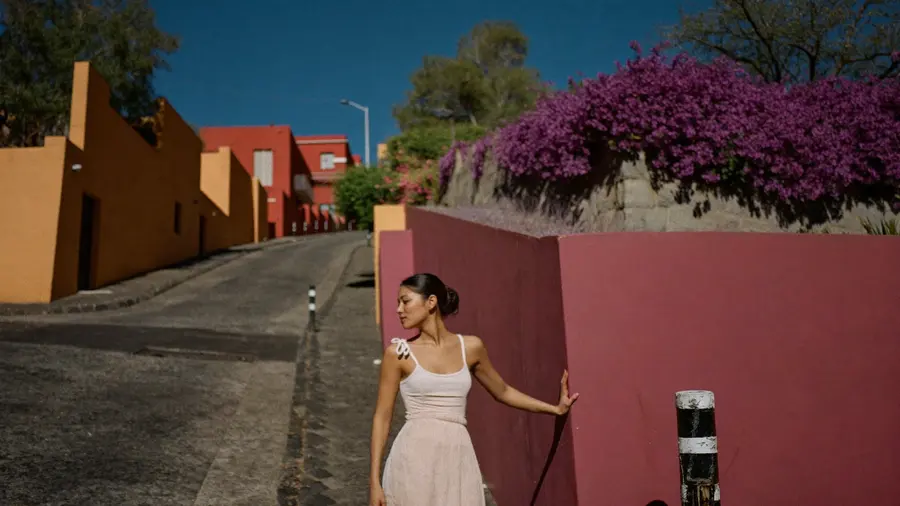
A slope that would be nothing at home will stop you halfway up in your first two days. It stops being noticeable by about the third.
The basin also runs the weather, and it does not behave like a tropical city. Summer is the rainy season: mornings are usually bright and the rain arrives in the late afternoon, heavily and briefly. Evenings cool off sharply whatever the day did, because two thousand metres of altitude take the heat back at sunset. Pack for a warm morning and a cold night on the same day.
It Was a Lake, and the Ground Still Remembers
The historic centre stands where an island city stood in a lake. The lake was drained over centuries, and what is under the oldest districts is soft former lake bed rather than rock. You can see the consequence without looking for it: colonial buildings lean into each other, floors slope, door frames sit out of square, and pavements ripple where the ground has settled unevenly beneath them. The city also draws water from below itself, which makes the sinking continue.
The same soft ground amplifies distant earthquakes, which is why the city takes them seriously in a way visitors find startling. A public alert system sounds through loudspeakers on poles across the city when a quake is detected on the coast, giving the capital a warning measured in seconds. You will hear it tested; there is a national drill every year in September.
-
Know the sound
A loud repeating two-tone signal from a street loudspeaker, with a spoken alert. It is not a car alarm and it is not a drill unless the date says so.
-
Do not run for the stairs
Staircases and doorways are where people get hurt. If you are inside and cannot reach the street in a few seconds, stay in.
-
Find the marked spot
Buildings mark safe zones and evacuation routes with painted signs. Notice yours when you check in, not when the alert sounds.
-
Expect the phones to jam
Voice calls fail first when everyone tries at once. Messaging usually gets through, so agree with whoever you are travelling with that you will text rather than call.
You Navigate by Colonia, Not by Street
An address here has a part most visitors leave out. It is a street, a number, and then a colonia — the named neighbourhood the street runs through — followed by a postal code. That is not decoration. Street names repeat across dozens of colonias, and a driver given a street and a number without one has been given several possible destinations spread across a metropolitan area of over twenty million people.
So copy the colonia along with everything else, and check that a pin you drop matches it. The same unit does the second job of deciding where you sleep: the part of the city most first visits actually use is a short list of adjacent colonias, and choosing one you can walk out of at night matters more than the building you choose inside it. A live map you can open on a corner, in the street, is what makes any of this workable — which is worth arranging before you land rather than in an arrivals hall, and our destination pages are where to start.
The Airport Trap Is Inside the Terminal
The main airport sits unusually close to the centre, which is the good news. The trap is that its two terminals are effectively separate airports. They are not connected once you are through security, and moving between them means leaving one building and travelling to the other on a shuttle train that is meant for passengers already holding an onward boarding pass, or on a road that has all the traffic the city can produce.
The practical consequence is about booking rather than about arriving. Two separately booked flights that land at one terminal and leave from the other are not a connection; they are two trips with a city crossing in between. Check the terminal on both tickets before you buy, and if they differ, give yourself hours rather than minutes.
A Marked Taxi and an App Car Are Not the Same Deal
How you leave the airport is the first real decision of the trip, and the three options differ in one specific way: when the price is agreed. Authorised airport taxis are bought at a desk inside the terminal, where you name your destination zone and pay a fixed fare before you meet the driver. Ride-hailing apps agree the fare in the app and record the route, and they have designated pick-up points that are usually a short walk from the door. Hailing an unmarked car off the street is the option to leave alone, here more than in most cities.
All of which assumes the phone works the moment the doors open, because an app car cannot be summoned from an airport lounge Wi-Fi network you lose at the kerb. That is the whole argument for sorting connectivity in advance — the mechanics of an eSIM take five minutes at home and considerably longer standing in an arrivals hall.
| Ride | Fare set | Watch for |
|---|---|---|
| Airport taxi desk | Before you board, by zone | Buy inside, not from someone offering outside |
| Ride-hailing app | In the app, route recorded | Needs a working connection, and its own pick-up point |
| Street hail | Agreed with the driver | Not worth it from the airport at any hour |
The Metro Is Cheap, and Direction Has a Name
The metro is the fastest thing in the city at rush hour and among the cheapest anywhere, and it is easy once you know that direction here is a place, not a compass point. Platforms are signed with the name of the station at the end of the line you are heading towards, so the useful thing to memorise is not your line's colour but its two terminus names. Get those and you will never stand on the wrong platform.
One rechargeable card issued by the city covers the metro, the articulated buses that run in dedicated lanes down the big avenues, the trolleybuses and the cable cars, so buy it early and top it up generously. Those bus lanes are often faster than a taxi on the same road. Two local rules are worth knowing: the front carriages are reserved for women and children and the reservation is enforced, and luggage larger than a daypack is not welcome at peak. If public transport in an unfamiliar city is the part you find hardest, the general method is worth reading first.
Meals Run Late, and it Moves Your Whole Day
The single biggest scheduling difference is that the main meal of the day is eaten in the middle of the afternoon. Lunch — la comida — starts at about two and runs to four, and it is the long, sit-down, several-courses meal that other countries put in the evening. Dinner is later and lighter, and kitchens do not really get busy until after nine.
What that means in practice is that a restaurant which looks dead at seven is not a bad restaurant, it is an early one, and that eating at noon puts you in an empty room being served by a kitchen that has not started. Shift everything back by two or three hours and the city stops feeling out of step. The set lunch offered at midday by small neighbourhood places is also the single best-value structure in Mexican eating, and it exists precisely because everyone is doing this at the same time.

Terraces are full when a visitor expects them to be empty, and empty when a visitor turns up for dinner. Move your clock, not your expectations.
Cash Is Not Optional, and Nor Is Small Change
Cards work in the places most visitors spend most of their money, and then stop working exactly where the trip gets interesting. Markets, street stalls, the small family kitchens worth crossing town for, tips and short taxi rides are cash. Carry some every day rather than planning a trip to a machine when you need it.
The real difficulty is denominations. Cash machines hand out the largest notes, and a market stall cannot break one — so break them yourself in supermarkets and pharmacies, and hoard the small notes and coins as though they were the useful currency, because they are. Two more habits: card terminals here often ask whether to add a tip before the payment goes through, so decide before the machine is in your hand, and if a terminal offers to charge you in your home currency, decline and pay in pesos — the reason is worth understanding once.
Three Days That Work with the City
Spend the first day inside one colonia on foot, at half the pace you had planned, with a late lunch and an early night. The altitude takes its cut whether you agree to it or not, and paying it on day one is much cheaper than paying it on day three. Use the second morning for the historic centre, before the afternoon rain and while the light is still good on the old stone, and put a museum or a gallery in the afternoon.
Keep the third day for one long move — a canal trip, an outlying district, the pyramids north of the city — leaving early and coming back before the evening traffic sets, because the return leg is where the day is won or lost. The one thing genuinely worth arranging before you fly is the connection all of this rests on: the map, the app car, the message to say you are running late.
Data plans for Mexico See what the networks there actually offer, and land with it already working.Common Questions
Will the Altitude Affect Me if I Am Fit?
Fitness helps less than people expect, and it is largely a matter of how quickly your body adjusts rather than how strong it is. Most visitors feel it for a day or two as breathlessness, a light head and poor sleep. Drinking a lot of water and going easy on alcohol on the first evening does more than anything else.
Is the Main Airport or the Newer One Better?
The main one, for a first visit, because it is close to the districts you will actually stay in. The newer airport to the north can be worth it for a much cheaper fare, but budget an hour or more each way and check what that costs you in a taxi before deciding it was cheaper.
How Much Spanish Do I Need?
Less than you fear in the central colonias and more than you expect anywhere else. Menus, markets and taxis are where it matters, and a phone that translates a photograph of a menu covers most of the gap. Learning the words for the meals is worth ten minutes, given how much the timetable matters here.
Can I See the City on Foot?
You can see a colonia on foot, and that is the right unit. The metropolitan area is enormous and no amount of walking joins it up, so treat each district as somewhere you travel to and then explore properly. Our destination pages cover the rest of the country when you start planning past the capital.