
You come up the escalator into a station you have never seen, in a city whose alphabet you may not read, and there is a machine, a gate, a queue and a man in a uniform. Somewhere in that picture is the correct way to pay, with three incorrect ones standing next to it.
Strip away the language and the livery, though, and a city has only four ways of taking a fare from you. Once you can tell which one you are looking at — from the barrier, before you commit — the rest is detail. This is the method: how to recognise each system on sight, what the fare underneath it looks like, the mistakes that turn a cheap ride into a penalty, the airport decision that costs the most, and which parts of it stop working when your phone loses signal.
Key takeaways
- There are four fare systems, not a hundred. Contactless bank card, local stored-value card, paper ticket you must validate, or an app.
- The gate tells you which one — read the reader, not the ticket machine.
- Almost every fine is a validation failure, not a fare dodge. A ticket you did not stamp counts as no ticket.
- The airport link is usually a separate product, priced on its own terms.
- Buying and planning need a connection. Riding, mostly, does not.
A City Can Only Take Your Fare Four Ways
The variety is superficial. Every network you will meet runs one of four models, and each has a recognisable shape at the gate.
| System | How you spot it | The risk |
|---|---|---|
| Bank card | Card logos on the reader | Forgetting to tap out |
| Stored-value | A named card sold at a desk | A queue, then a dead balance |
| Paper ticket | A stamping box past the till | Not validating it |
| Operator app | A code, few or no gates | No signal when you must buy |
Contactless has spread fastest, because it asks the traveller for nothing they were not already carrying. The Netherlands completed a nationwide rollout in 2023 — trains, buses, trams and metro on one tap — and in London contactless is now the majority of pay-as-you-go travel. Where it exists it is almost always the right answer for a visitor.
Stored-value cards are what contactless is replacing, and they remain the default across much of Asia: buy a named card, load money onto it, tap. Flawless in use, at the cost of a queue on arrival and a leftover balance on departure. Paper survives in many European cities alongside something newer, and it is the model that generates the fines. App-only networks are the most fragile for a visitor, because they assume the one thing a person who has just landed may not have.
Note
Several large networks are mid-migration and run two models side by side. Where that happens the operator usually makes the new gates look deliberately unlike the old ones — different colour, different reader, sometimes a separate lane. Trust the difference; it is a signal, not decoration.
How to Tell Which One You Are Looking At
Fifteen seconds, and it belongs before the queue rather than after.
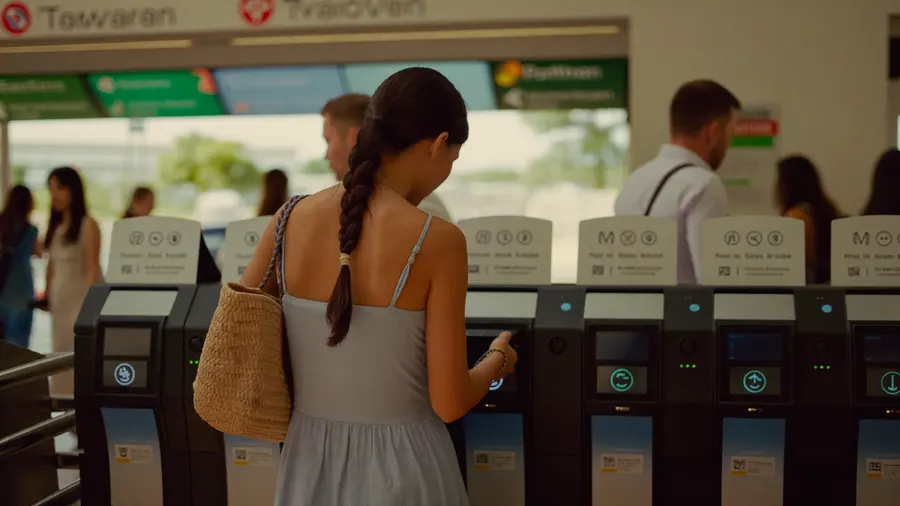
The ticket machine sells whatever the operator would like to sell you. The reader on the gate tells you what the gate will actually accept, and those are not always the same list.
- The reader on the gate. Card network logos on the pad mean bank cards are accepted. A pad carrying only the transport authority's own mark means a local card, and yours will be refused.
- What the people ahead of you are holding. The most reliable indicator in any station. Phones mean an app or a wallet; identical plastic cards mean stored value; wallets held flat against a pad mean contactless.
- Whether there is a separate box on the wall. A small standalone unit past the ticket counter, or by the doors of a tram, exists for one reason: to stamp paper.
Where there are no gates at all — most tram and bus networks — the barrier is a person who boards later and asks. That does not make the fare optional; it makes validation the entire system, and it is where visitors are caught.
The Fare Shape Underneath the Payment Method
How you pay and what you are charged are separate questions. Learn the shape and you can predict the cost of a day without knowing a single amount.
| Shape | How to spot | What it means |
|---|---|---|
| Flat fare | One price on the board | Distance is irrelevant |
| Time-based | Tickets sold in minutes | Transfers free in it |
| Zones | A ringed map by it | Check the ring you sleep in |
| Distance | A fare table above it | You must tap out as well |
Layered on top of several of these is a cap: once your taps in a day or a week reach the price of a pass, the rest of your travel is free. Capping removes the decision most visitors get wrong — whether to buy a day ticket — and it means a tourist pass sold at the airport can be worse value than simply tapping.
If the network caps your daily spend, you do not need to be clever. You only need to use the same card all day.
Caps are calculated per payment card. Tap in with the plastic and out with the phone and the system sees two travellers on two incomplete journeys, and prices both at the maximum.
Validation Is the Rule Travellers Break Most
This is the most expensive misunderstanding in urban transport. In a validation system, buying is not paying: the ticket becomes valid when it is stamped, and until then it is a piece of paper you happen to own.
Italy's regional trains are the textbook case. A paper regional ticket carries no date, no time and no name, so it is validated in a machine on the platform before boarding, and an unvalidated one is treated in law as no ticket at all. The same logic runs through trams and metros across central and eastern Europe, where a ticket bought from a kiosk in the morning stays inert until it goes through the box on the vehicle.
Warning
Inspectors are not hunting for people with no ticket — those are rare. They are looking for people holding an unstamped one, because that is the common mistake and the penalty is the same. Having bought it, and being able to prove you bought it, is not a defence.
Penalties are a fixed sum many times the fare, collected on the spot or by post, and in some countries repeated fare evasion is criminal rather than administrative. Two habits remove the risk: stamp it the moment you board, and keep the stub until you are out of the far station.
Tip
If you realise mid-journey that you have not validated, find the inspector or the driver before they find you. Declaring it usually costs a small fee or nothing. Being caught with it costs the full penalty.
The Airport Decision Is Its Own Problem
Almost every traveller meets a city's transport at its least representative point. The airport link is frequently a separate commercial product — its own operator, its own ticket, and often no place in the city's zones or caps at all.

The pattern repeats worldwide. A branded express runs non-stop to one central terminus at a premium, while an ordinary commuter line, a metro branch or a city bus serves the same airport more slowly, more cheaply and inside the normal fare structure. In London the dedicated express to Heathrow sits outside Travelcard and capping entirely; a standard line serving the same airport is fully inside them.
Three questions settle it before you land: where does the express terminate — a fast train to the wrong side of a city is a slow journey; is the airport inside the normal zones, in which case the ordinary service usually wins and starts your cap running; and what time do you land, because rail links keep shorter hours than roads.
Airports are also where you meet the worst prices for everything else — including the ticket machine's offer to charge your card in your own currency, which is the one offer to decline every time. For a specific airport, our airport guides cover the routes into town terminal by terminal.
What Needs a Connection, and What Works Offline
Modern transport depends on your phone less than it feels, and more in exactly the places that hurt.

The diagram on the carriage wall — or a photograph of it in your phone — is the only part of this that never asks for a signal.
Works offline
- Tapping a bank card or stored-value card at a gate.
- A transit card already added to your phone wallet.
- A ticket or QR code downloaded before you lost signal.
- A transport map saved as an image.
Needs a connection
- Buying anything in an operator's app.
- Adding a transit card to a wallet the first time.
- Live departures, delays and diversions.
- Public transport directions in a map app.
The last one catches people who thought they had prepared. An offline map area gives you streets and driving navigation; transit, walking and cycling directions are not included and simply refuse to appear. It will not tell you which platform, which direction, or which of four exits to take.
So you can ride an unfamiliar network offline, but you cannot easily work one out offline — and the first hour is entirely working it out. That is the hour a data plan pays for itself in, however you get one: an airport network, a local card, or an eSIM activated before you left home.
Six Things That Catch Visitors Out
- Tapping in and not out. A reader that never saw the journey end charges the maximum — which usually does not count towards the daily cap either.
- Two people, one card. On most contactless networks a card is a person, so tapping a partner through on yours is fare evasion in the rules.
- Switching between card and phone. Different tokens to the system, even on one account. Start and finish the day with the same one.
- The unstamped ticket in your pocket. Bought, unused, inert. This is the one that generates the fines.
- The tourist pass bought on arrival. Sold hardest where you are least able to compare, and often beaten by the network's own cap.
- The last departure. Metros and airport rail close before the city does, and a line running every four minutes at six can run every twenty at eleven.
Your First Hour, in Order
-
Before you fly, find out which of the four it is
One search on the operator's own site, not a forum. You want a single answer: what is a visitor expected to pay with.
-
Save the network map as an image
Not a link — a picture in your photos. It works in a tunnel and on a dying battery.
-
Sort connectivity before you leave the terminal
Everything below is easier online, and the terminal is the last guaranteed network.
-
Decide the airport route on the map, not at the desk
Express or ordinary line, and where each leaves you relative to your bed.
-
At the first gate, read the reader before you queue
Logos, the people ahead of you, and whether a stamping box exists.
-
Check what was actually charged
A banking notification after the first tap tells you the fare shape, whether capping applies, and whether the system recognised you at all.
Common Questions
Should I Buy a Tourist Travel Pass?
Only once you know whether the network caps daily spending. If it does, tapping a bank card earns the pass automatically and costs nothing if you fall short. Where there is no cap and you are making four or more journeys a day, a pass usually wins.
Is a Local Stored-Value Card Still Worth Buying?
If the network does not take bank cards you have no choice. Where both work, weigh the queue on arrival and the balance you leave behind against the convenience. Many now live inside a phone wallet, which removes the queue but needs a connection to set up.
What if the Machine Will Not Take My Card?
Try the contactless pad rather than the slot, then a second card from a different bank. Failing that, find a staffed counter — almost every large network still has one, and it can sell you a paper ticket.
Do I Need Mobile Data to Use a City's Transport?
To ride, usually not. To plan, buy, check a delay or find the right exit, yes — and that is most of what you do in an unfamiliar city. Working out how much data a trip needs is a five-minute job before you go.
What Happens if I Get It Wrong?
Usually less than you fear. Inspectors deal with confused visitors all day, and a mistake declared early is treated differently from one discovered. Show what you bought, say what you did not understand, and settle it without arguing in the door of a tram.
The Short Version
Four systems, and the gate tells you which one you are in if you look at it for fifteen seconds. Validate anything paper the moment you board. Use one payment method all day, so the network can recognise you and cap you. Treat the airport link as a separate product. Do your working out while you still have a connection, and save the map as a picture for when you do not.
None of that requires knowing a city in advance — only knowing which four questions to ask, which is the same list in every city you will ever land in.
Land with the phone already working The first hour in a new city is the one that most needs a connection. See what a plan costs where you are going.