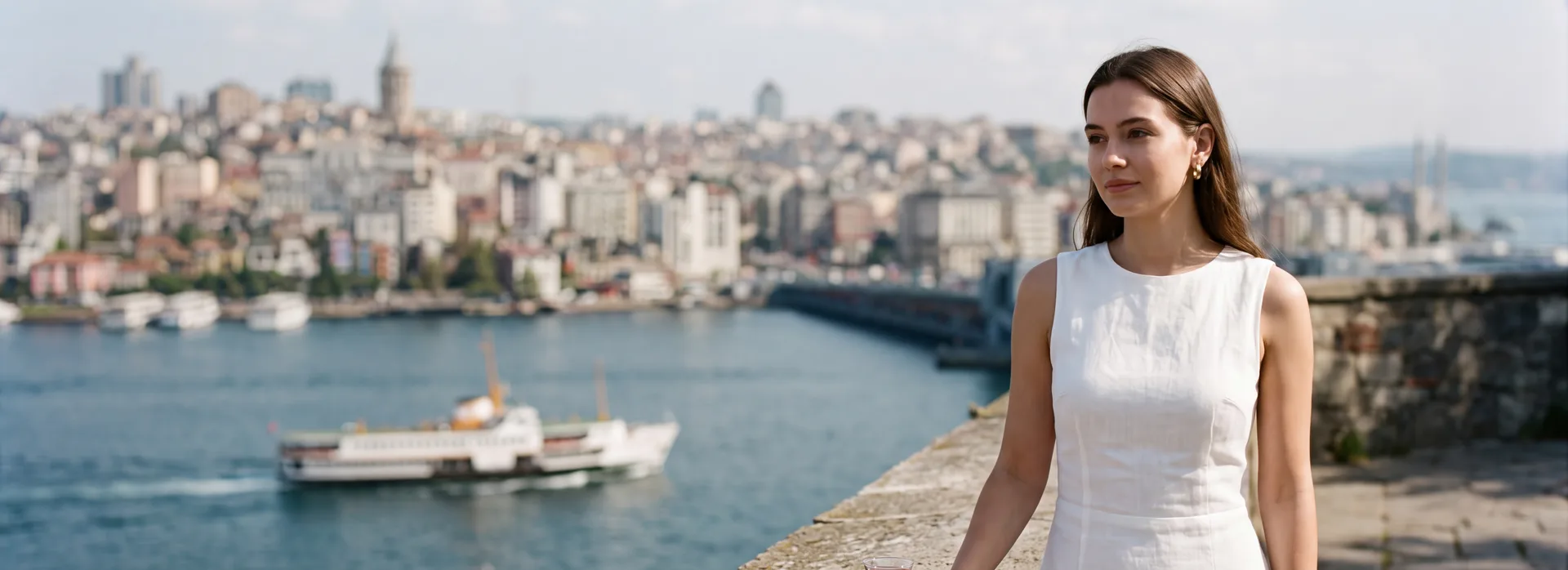
Istanbul is the city first-time visitors most often call enormous, and its size is not really what they are reacting to. It is that Istanbul is not one place. It sits on two landmasses with a working shipping strait running between them, and almost every practical decision a visitor makes here — which airport to book, where to sleep, how long anything takes — turns out to be a decision about water.
So this is not a list of monuments. The monuments are the easy part and they take up far less of a trip than people expect. This is the shape underneath them: which shore you land on, how you cross between them, what a quoted price actually means, and why the buildings you came to see are still in use rather than on display.
Key takeaways
- Book the airport and the bed together — the two airports sit on different continents, and one of them is a long way from anywhere.
- Buy the travel card on day one — a single card covers the trams, metro, funiculars, buses and the ferries.
- The ferry is a bus, not a tour. It is also the fastest pleasant way between the two sides.
- Give the famous square half a day. Everything else worth your time here is a neighbourhood rather than a monument.
Istanbul Is Two Landmasses and Three Shores
Most cities are organised around a centre. Istanbul is organised around a strait. The Bosphorus separates the European side from the Asian side, and a second inlet, the Golden Horn, cuts the European side into two halves of its own. That gives a visitor three shores, not two, and they behave completely differently.
South of the Golden Horn is the historic peninsula, where the great domes are and where almost every photograph of the city is taken. North of it is the modern European city, built up the hill, where most of the bars, the concert halls and the good hotels are. Across the water on the Asian side is where a large part of the population actually lives, and it feels less like a sight than like a city getting on with its evening.
Two places a few hundred metres apart as the gull flies can be forty minutes apart in practice, because one of them is across a shipping lane. Distance here is measured in crossings, not in kilometres.
Your Airport Chooses Your Continent, Not Your District
Istanbul has two international airports and they are not on the same landmass. The vast newer one is on the European side, well to the north-west of everything, and it is connected by metro, by frequent airport buses and by road. The smaller one sits on the Asian side, to the south-east, handles a lot of low-cost traffic, and reaches the city centre by a longer combination of bus, metro and, usually, a change.
Neither is the wrong airport. The mistake is comparing two fares as though the ground journey afterwards were the same, and then discovering that the cheap flight lands on the opposite continent from the room you booked, at an hour when the last ferry has gone and the bridge is the only option left. Check which airport the flight actually uses before you book the hotel, not after.
Both airports have official taxi ranks, and both have people standing near them offering something else. The way past that conversation is the ride-hailing app on your phone, which needs a working connection the moment you clear the doors — one of several reasons to sort out data before you fly rather than in an arrivals hall at two in the morning.
The Ferry Is a Commuter Boat, Not an Excursion
The single most useful thing to understand about Istanbul is that the boats are public transport. Ferries run all day between the two sides and up the Golden Horn, on a timetable, from piers that people use to get to work. They are not a sightseeing product and they are not priced like one. They are also, by some distance, the best twenty minutes of the day.
They run on the same fare system as everything else. One rechargeable contactless card — the İstanbulkart — is tapped on the trams, the metro, the funiculars that save you the steep hills, the buses and the boats. Buy it from a machine at any station, load it, and stop thinking about tickets. Transfers within a window are discounted, so a journey made of three legs is not billed as three full fares.
The phone does the rest of the work: which pier, which boat, how long until the next one, and whether the metro under the strait is the faster answer right now. That is a lot to ask of a handset, and whether yours can carry a travel line alongside your usual number is worth checking at home, where the answer costs five minutes rather than a queue.
| Crossing | Good for | Catch |
|---|---|---|
| Ferry | Any crossing you are not late for | Timetabled, and it thins out late |
| Rail tunnel | Getting under the strait quickly | Underground, so no view at all |
| Bridge by road | Luggage, late nights, four people | The bottleneck everyone shares |
| Tram or metro | Moving along one shore | Mostly does not cross the water |
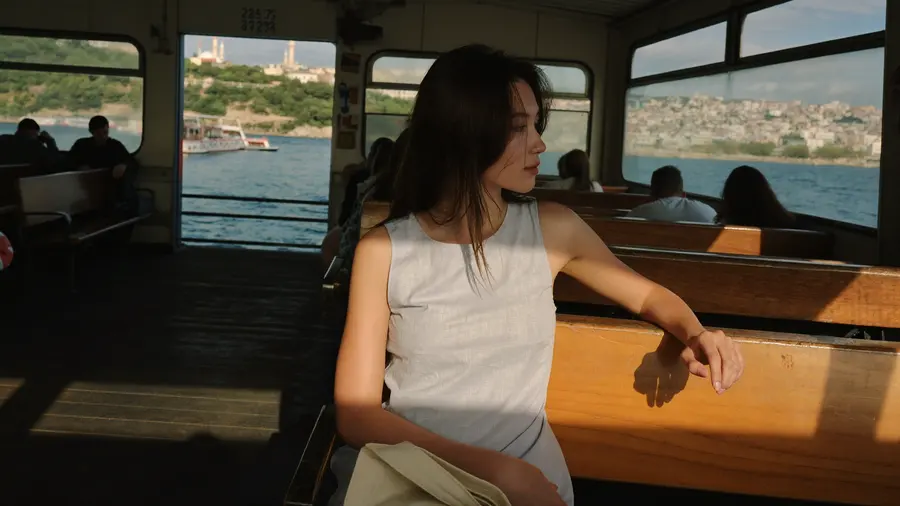
The scheduled commuter crossings go where you were going anyway, and they see the same water as anything sold as a cruise.
The Famous Sights Fit into One Square
Here is the fact that reorganises a first trip. The buildings almost everybody comes for — the great domed church that became a mosque, the imperial mosque facing it, the palace, the underground cistern, the long open space that was once a Roman chariot track — are all within a few minutes' walk of one another on the historic peninsula. They are not scattered across the city. They are essentially one square.
That is generous of the city, and it is also a trap, because it makes the headline list feel like the whole trip. A determined morning covers most of it, and a visitor who plans three days around that square spends two of them queueing among people all doing the identical thing.
The rest of Istanbul is neighbourhoods, and they are the reason to come back. A steep residential hill with a view of the water at the end of every lane. A market street that sells to the people who live on it. A stretch of waterfront on the Asian side that is entirely uninterested in tourism. None of these are attractions, which is precisely why they are worth the afternoon.
Nothing Here Ever Stopped Being Used
Istanbul has been the capital of two empires and it has never been excavated into a ruin, because it has never been empty. Layers here sit on top of each other and remain in service: a Roman wall holding up a modern shopfront, a Byzantine cistern under a street of carpet shops, an Ottoman fountain on a corner that people still park beside. One building has been a cathedral, a mosque, a museum and a mosque again.
That has a practical consequence most guides skip. The great mosques are working places of worship, not exhibits with opening hours. They close to visitors around each of the five daily prayers and for longer around midday on Friday, which is the single most common reason a visitor arrives to find a door shut and assumes it is broken. Plan around prayer times and the whole day gets easier.
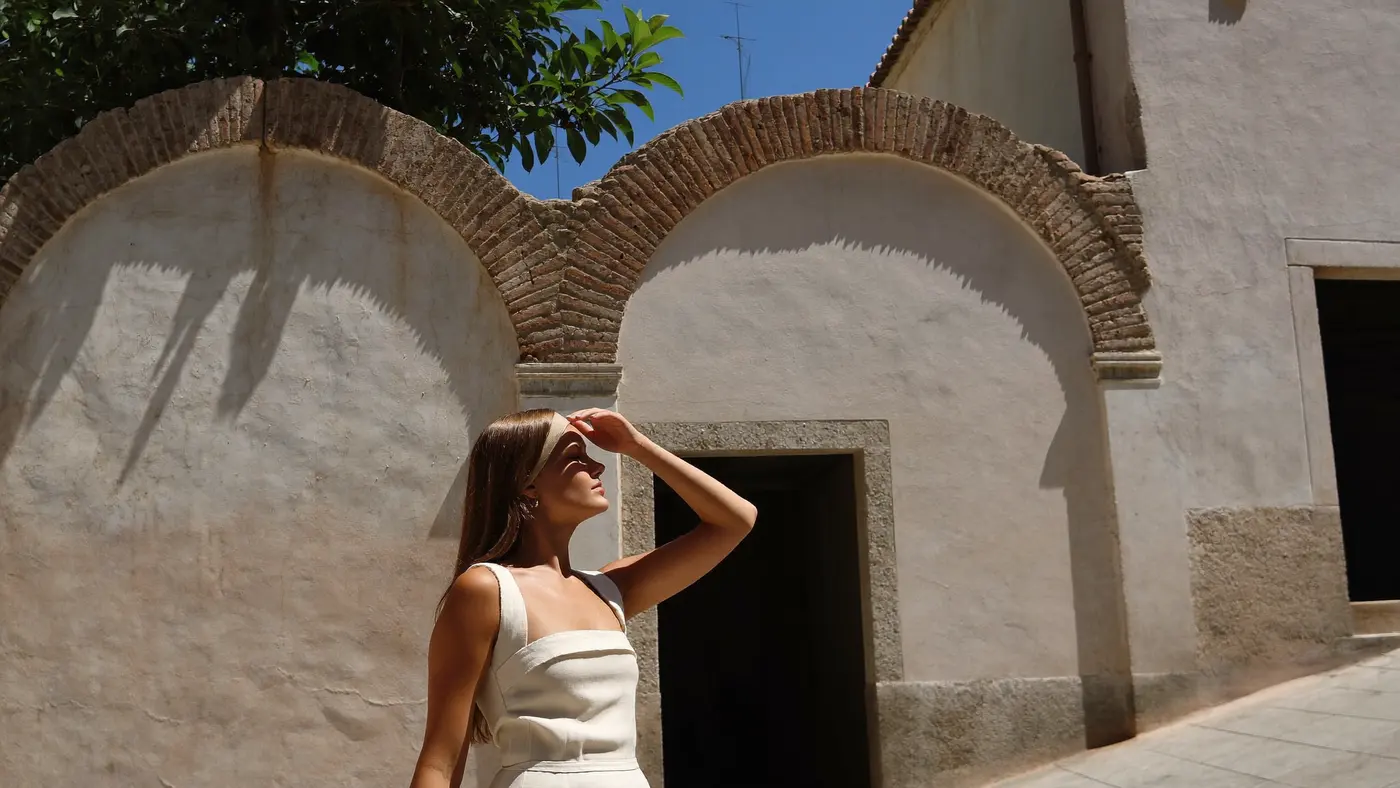
Most mosques ask nothing for entry, and the handful that also run a ticketed visitor section are the exception rather than the rule. What is asked of you is straightforward and enforced at the door: shoes off, shoulders and knees covered, and a head covering for women. Wraps are lent out at the busy ones, but bringing a scarf saves the queue.
Do
- Carry a light scarf and wear something with sleeves on mosque mornings.
- Take your shoes off and carry them, rather than leaving them where you cannot see them.
- Walk behind anybody who is praying, never across in front of them.
Don't
- Turn up at midday on a Friday and expect to get in.
- Photograph people at prayer, however good the light is.
- Assume a closed door means permanently closed. Come back in half an hour.
What a Price Means Changes by the Metre
Turkey is comfortable with cards. Contactless works in most cafés, shops and taxis, and the travel card can be topped up the same way. What catches visitors is not whether a card is accepted but what the number attached to it means, because that changes depending on where you are standing.
In a supermarket, a lokanta or a chain, the price is the price and there is nothing to discuss. In the covered bazaars and the shops that surround the famous square, the first number is an opening position and everyone involved knows it. Neither is dishonest. Reading which of the two you are in is the actual skill, and the tell is simple: if the item has a label on it, the conversation is over.
Tea is hospitality, not a deposit. Drinking it obliges you to nothing.
Two more mechanics are worth knowing. The lira has moved a great deal in recent years, so any figure you read in an older article is decoration rather than information — check the current rate the morning you land. And if a card terminal or a cash machine offers to charge you in your own currency instead of the local one, decline: that conversion is set by the machine's owner, not by your bank, and the reasoning is laid out in our guide to paying abroad without losing money to fees.
Breakfast Is a Meal, Not a Habit
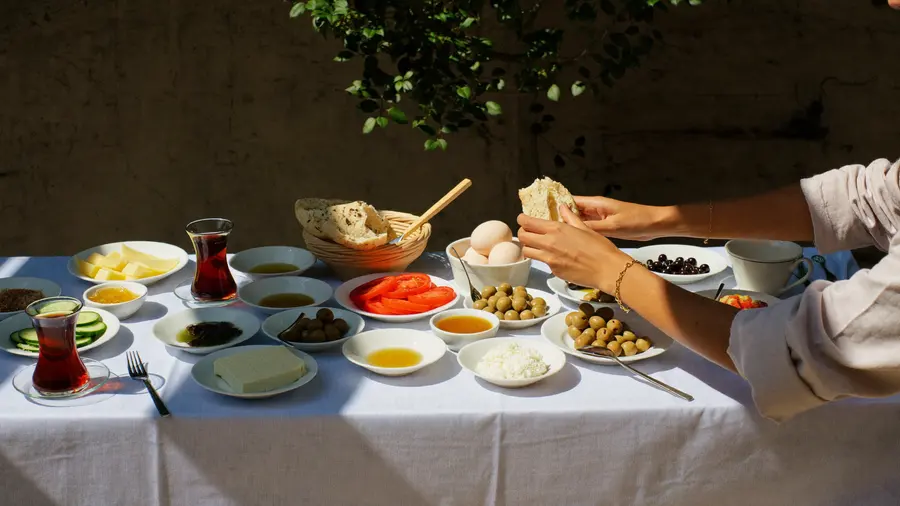
A proper Turkish breakfast is a long table of small dishes shared slowly. It replaces lunch, and it is the cheapest good meal of the day.
Eating here is organised by the time of day rather than by the type of restaurant, and once that clicks the menus stop being confusing. The morning belongs to breakfast, which is a genuine event: cheeses, olives, tomatoes, eggs, jam, honey and bread, brought all at once and eaten over an hour or two. Nobody is in a hurry and neither should you be.
Lunch is the workers' meal, and the place to eat it is a lokanta — ready-cooked dishes in trays behind glass, where you point at what you want and it appears immediately. It is fast, it is what the neighbourhood eats, and it removes the language problem entirely.
The evening is the long one. A meyhane serves small plates over several hours with the assumption that the table is not going anywhere. Order a few, then order a few more; sending the whole meal out at once is not how it works. Fish is a coastal city's obvious answer and it is priced by weight, so ask what a portion costs before it goes on the grill rather than afterwards.
Three Days, One per Shore
Give the first day to the historic peninsula and finish with it. One concentrated morning around the famous square, an afternoon in the market streets behind it, and no attempt to return the next day. Give the second to the northern European side: walk up the hill, use the funicular when the hill wins, and let the evening happen where the city goes out.
Spend the third on the Asian side, and cross by boat both ways. It is the day that changes people's minds about Istanbul, because it is the one where nothing is arranged for a visitor's benefit. Everything else — a longer trip up the Bosphorus, the islands, a hammam — hangs off whichever of the three days you liked best.
The one job worth finishing before you leave home is connectivity, because it sits underneath all of it here: the pier timetable, the car at the kerb, the exchange rate you want to check in a bazaar, the map on a hill where every lane looks the same. It is a five-minute task on your own sofa and a bad one in a queue.
Data plans for Turkey See what the networks there actually offer, and land with it already working.Common Questions
Is Three Days Enough for a First Visit?
Three full days is the point at which Istanbul stops being a checklist and starts being a city. Two is enough to see the famous square and one neighbourhood properly, which is a real trip. Beyond four, most people are better served by using Istanbul as the hinge it has always been and taking a few nights somewhere else on either side of it.
Which Shore Makes the Better Base?
The northern European side, for a first visit. It puts you on the tram and metro network, walking distance from the nightlife, and one short crossing from the historic peninsula. Sleeping beside the monuments sounds efficient and mostly means eating badly, among other visitors, in the one part of town that empties after dark.
How Far Does English Get You?
Further than you would expect in the tourist areas and the hotels, and not far at all three streets away — which is exactly where you want to be eating. A phone that can translate a photograph of a handwritten board is worth more here than a phrasebook, and a few words of Turkish are received warmly out of all proportion to their accuracy.
What Is Worth Sorting out before You Fly?
Your first two nights, your route in from whichever airport you are actually landing at, and your data. Very little else needs booking: ferries, mosques and most restaurants are walk-up. What a trip like this consumes is something we have worked through separately, and if Istanbul is one stop on a longer run, our destination pages cover the rest of it.